




If you’re comparing options for a Business Analyst course in Australia, you’re looking at one of the fastest-growing career paths in the country. As companies in Melbourne, Sydney, Brisbane, Perth, Adelaide and Canberra push ahead with digital transformation, cloud adoption and AI-driven process change, they need people who can sit between business goals and technology solutions and make sense of both. That person is the Business Analyst (BA).
This guide walks you through exactly how to become a Business Analyst in Australia in 2026: the skills employers expect, the certification-based Business Analyst course options that carry real weight, realistic salary expectations, and a step-by-step plan you can start on this week.
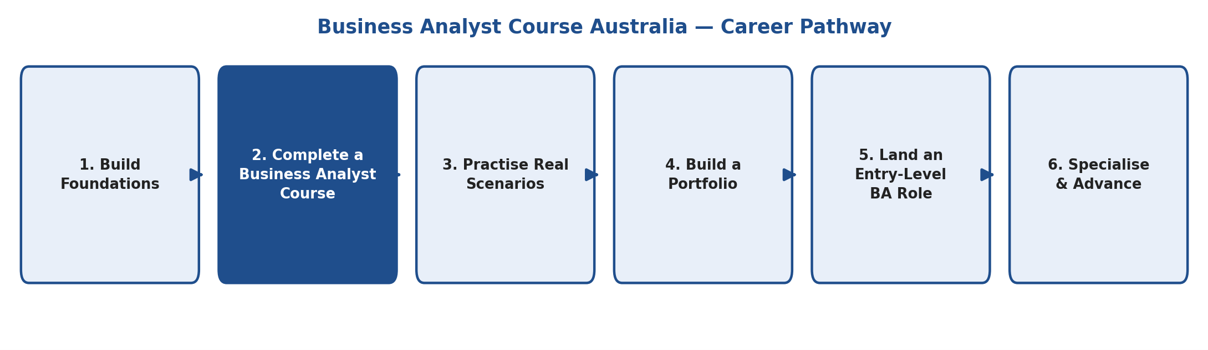
The six-step pathway from a Business Analyst course to a specialised BA career
What Does a Business Analyst Actually Do?
A Business Analyst identifies business problems, gathers and documents requirements, and recommends solutions that improve processes, systems and outcomes. In practice, this means running stakeholder workshops, mapping current and future-state workflows, writing user stories and functional specifications, and validating that delivered solutions actually solve the original business problem.
The role sits at the intersection of business strategy, project delivery and technology, which is why BAs are found everywhere from banking and insurance to healthcare, government, retail and IT consulting.
Core Skills a Business Analyst Course Should Teach You
A good Business Analyst course builds a mix of technical and interpersonal skills. These are the fundamentals employers across Australia consistently look for, well before any certificate enters the picture.
- Requirements elicitation and documentation — running interviews, workshops and surveys to capture accurate business needs
- Business process modelling — mapping workflows using tools such as BPMN and process flow diagrams
- Stakeholder management and communication — translating between technical teams and business decision-makers
- Data analysis and problem-solving — using tools like Excel, SQL and reporting dashboards to support recommendations
- Agile and Scrum fundamentals — writing user stories, managing backlogs and working within sprint cycles
- Critical thinking and structured analysis techniques — SWOT, gap analysis, root-cause analysis and cost-benefit analysis
- Familiarity with cloud platforms such as AWS or Azure, increasingly expected in technology-heavy BA roles
Choosing the Right Business Analyst Course and Certification
Certification is what turns raw skills into a credential employers can verify. In the Australian market, a handful of training and certification pathways carry the most weight.
1. BCS Business Analysis Foundation
Offered by BCS, The Chartered Institute for IT, this Business Analyst course is widely regarded as the entry-level standard for business analysis in the UK, Europe and Australia. It covers core BA concepts, techniques and terminology and is a common starting point for career changers.
2. Agile Business Analyst (AgileBA) Foundation
As more Australian organisations run Agile and Scrum delivery models, an AgileBA Foundation qualification demonstrates you can apply business analysis techniques within iterative, sprint-based projects — a skill set employers now expect as standard rather than a bonus.
3. IIBA Certifications (ECBA, CCBA, CBAP)
The International Institute of Business Analysis (IIBA) publishes the BABOK Guide, the industry reference framework for business analysis practice. Its certification track, starting with the Entry Certificate in Business Analysis (ECBA) and progressing to CCBA and CBAP, is recognised globally and often referenced in senior BA job ads.
4. Business Analysis Practice Practitioner & Techniques Courses
A practical, techniques-focused program that goes beyond theory into applied requirements gathering, documentation and stakeholder workshops is valuable alongside formal certification, particularly for people transitioning from another profession.
Your Step-by-Step Career Pathway
- Build foundational knowledge — understand the BA role, the project lifecycle, and how requirements flow from business need to delivered solution.
- Complete a recognised Business Analyst course — such as BCS Business Analysis Foundation, AgileBA Foundation, or a Business Analysis Techniques program, delivered full-time, part-time or online.
- Practise with real-world scenarios — case studies, mock stakeholder interviews and process-mapping exercises build the confidence theory alone cannot.
- Build a portfolio — document sample requirements specifications, process maps and business cases you can show in interviews.
- Target entry points into the industry — business analyst trainee roles, junior BA positions, or lateral moves from adjacent roles such as project coordination, QA or customer operations.
- Specialise as you grow — Agile BA, technical BA, data BA or business process analyst are common specialisations that increase earning potential.
- Pursue advanced certification — CCBA or CBAP once you have several years of documented BA experience, to open senior and lead BA roles.
Business Analyst Salary Expectations in Australia (2026)
According to SEEK career advice data, Business Analyst salaries in Australia vary by experience, location, industry and specialisation, but the overall trend for 2026 is strong and growing, driven by digital transformation and AI-implementation projects across every major sector.
- Entry-level Business Analyst: roughly AUD 70,000–90,000 per year
- Mid-level Business Analyst: roughly AUD 100,000–120,000 per year
- Senior Business Analyst: roughly AUD 130,000–160,000+ per year
- Specialised roles (Agile BA, technical BA, industries such as finance, healthcare and insurance) often sit at the top of these ranges
Salaries also tend to be higher in major cities such as Sydney and Melbourne, where the concentration of banking, consulting and technology employers is greatest. Contract BA roles can pay a further premium over permanent positions for professionals with proven delivery experience.
Business Analyst Course Options by City
Training is available across Australia’s major cities, as well as through live online delivery for learners who need flexibility. Look for a Business Analyst course that combines recognised certification (BCS, AgileBA) with hands-on practice, current material aligned to industry trends, and post-course support through to certification and job search.
- Melbourne — city classes and live online options
- Sydney — full-time and part-time weeknight formats
- Brisbane — weekday and weekend intakes
- Perth — in-person and virtual classroom access
- Adelaide — flexible scheduling for working professionals
- Canberra — public sector-aligned training options
Full-time, part-time weeknight and weekend formats are widely available, making it realistic to complete your training while working or studying.
Frequently Asked Questions About a Business Analyst Course in Australia
Do I need a university degree to become a Business Analyst in Australia?
No. While a business, IT or related degree helps, many successful BAs enter the profession through an industry-recognised Business Analyst course such as BCS Business Analysis Foundation or AgileBA Foundation, combined with practical project experience.
How long does a Business Analyst course take to complete?
Foundation-level Business Analyst courses typically run from a few days up to several weeks part-time. Most career changers land an entry-level BA role within three to twelve months of completing structured training and building a small portfolio of practice work.
Which certification should I start with — BCS or IIBA?
BCS Business Analysis Foundation and AgileBA Foundation are strong, accessible starting points for beginners. IIBA’s ECBA, CCBA and CBAP are better suited once you have some hands-on BA experience and want a globally recognised, experience-based credential.
Can I become a Business Analyst without an IT background?
Yes. Business analysis draws heavily on communication, stakeholder management and structured problem-solving, which makes the field accessible to people moving from operations, customer service, finance and healthcare administration.
Is Agile experience necessary for Business Analyst roles?
It is increasingly expected. Most Australian organisations run some form of Agile or Scrum delivery, so training that covers sprints, backlogs and user stories is a strong advantage even outside pure Agile roles.
What industries hire the most Business Analysts in Australia?
Banking and financial services, insurance, healthcare, government, retail and IT consulting are consistently the biggest employers of Business Analysts across Melbourne, Sydney and Brisbane.
Ready to start your career?
Explore an accredited Business Analyst course in Melbourne, Sydney and Brisbane, with full-time, part-time and live online options, or contact our team to find the right fit for you.