
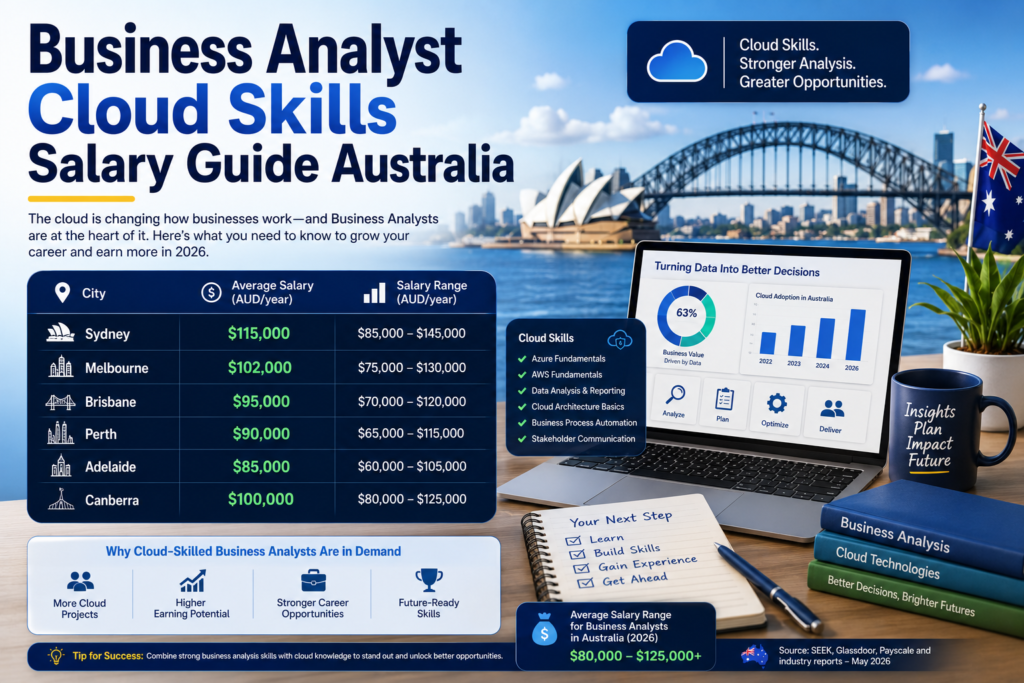



Business Analyst cloud skills salary data is becoming one of the most searched topics among Australian BAs in 2026, and for good reason it’s quietly become the single fastest way to increase your pay without changing job titles. Short answer: adding AWS or Azure literacy to a standard BA skillset can add $15,000 to $25,000 to your base salary. “Worth it” depends on your current stack, your industry, and how deliberately you build the skill rather than just adding a buzzword to your resume.
This guide breaks down why Business Analysts across Australia are adding cloud skills in 2026, exactly what it does to your salary, which certifications are worth the time, and a realistic plan to build cloud literacy without becoming a full-time engineer.
Why Business Analysts Are Adding Cloud Skills in 2026
The BA role hasn’t fundamentally changed you’re still translating business problems into requirements a delivery team can build against. What’s changed is where that delivery happens. Most Australian enterprises have now migrated core systems to AWS, Azure, or Google Cloud, and BAs who can’t speak the language of that environment are increasingly boxed out of the more interesting, better-paid projects. A few forces are driving this:
- Digital transformation and cloud migration projects are among the biggest sources of BA demand right now
- ICT Business Analyst roles have sat on Australia’s persistent skills shortage list for several years running
- Organisations integrating AI across operations need BAs who understand the cloud infrastructure that AI tools run on
- Financial services, mining, and government the sectors paying the highest BA salaries are also the most cloud-heavy environments
None of this means a BA needs to become a cloud engineer. It means understanding how cloud environments work well enough to write requirements, assess feasibility, and talk credibly with technical teams — without needing a developer to translate for you.
For a live view of current BA openings and advertised pay, see SEEK Career Advice: Business Analyst salary.
Business Analyst Cloud Skills Salary Australia 2026: The Real Numbers
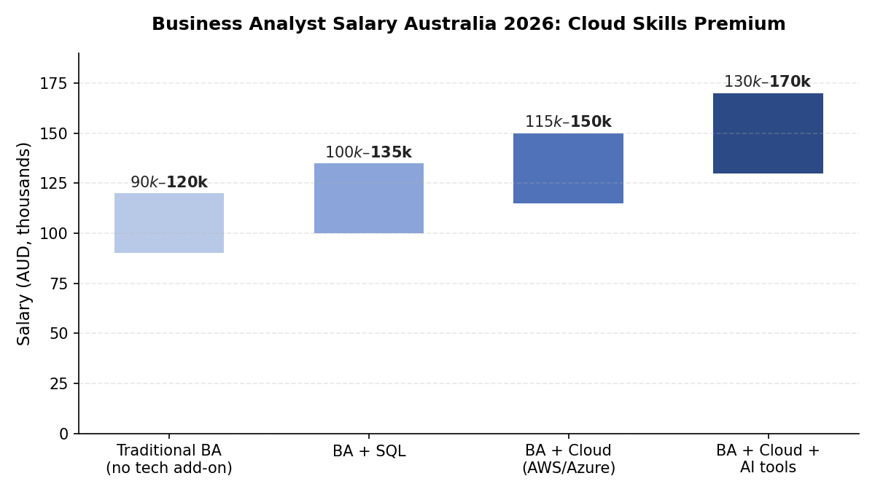
Business Analyst cloud skills salary data confirms what recruiters have been saying anecdotally for a while: technical add-on skills move pay more than years of experience alone at the mid-career stage. Here’s how the premiums stack up.
| BA Skill Combination | Typical Salary Impact (AUD) |
| Traditional BA (documentation, workshops, requirements only) | $90,000–$120,000 baseline |
| BA + SQL / data querying | +$10,000–$15,000 on top of baseline |
| BA + Cloud platform knowledge (AWS or Azure) | +$15,000–$25,000 on top of baseline |
| BA + Automation tools (Power Platform, workflow automation) | Meaningful premium, often bundled into senior/lead bands |
| BA + Cloud + AI-assisted delivery tools | Top of market — $130,000–$170,000+ in senior roles |
For context, the general Business Analyst salary in Australia sits between roughly $90,000 and $125,000 for permanent roles, with senior and specialised BAs in financial services or technology reaching $130,000–$160,000. Cloud skills are one of the fastest ways to move from the bottom of that range to the top of it often faster than waiting for another year of tenure.
Contract rates tell the same story even more sharply: contractors with cloud and automation skills typically earn 40–60% more per day than permanent-equivalent roles, and BAs who move into contracting with a strong cloud skillset often see their effective annual income jump by $30,000–$50,000 within two years.
Business Analyst Cloud Skills Salary by City
Cloud-skilled BA demand isn’t evenly spread. Sydney and Melbourne have the deepest concentration of cloud-migrated enterprises and financial services firms paying a premium for the combination. Canberra’s government cloud transformation programs are a strong, steady source of demand. Perth’s resources sector and Brisbane’s growing tech scene are catching up quickly.
Sydney Business Analyst roles — the deepest cloud-BA market, financial services and enterprise cloud migration driving premium pay. View Sydney courses
Melbourne Business Analyst roles — strong in financial services, government, and a growing technology sector; senior cloud-skilled BAs often clear $140,000+. View Melbourne courses
Brisbane Business Analyst roles — growing tech and government cloud transformation demand, strong take-home value. View Brisbane courses
Perth Business Analyst roles — resources and energy sector cloud migration work, competitive contract rates. View Perth courses
Adelaide Business Analyst roles — defence and government-adjacent cloud work, smaller volume but stable. View Adelaide courses
Canberra Business Analyst roles — government cloud transformation programs consistently pay a premium over the national average. View Canberra courses
Which Cloud Certifications Are Worth It for Business Analysts?
You don’t need an engineering-grade certification to see a Business Analyst cloud skills salary bump foundational, BA-relevant credentials are usually enough to open the door.
| Cloud Credential | Provider | Best for BAs |
| AWS Certified Cloud Practitioner | Amazon Web Services | Foundational cloud literacy, fastest entry point |
| Microsoft Certified: Azure Fundamentals (AZ-900) | Microsoft | BAs working in Microsoft-stack enterprises |
| AWS Certified Solutions Architect – Associate | Amazon Web Services | BAs moving toward technical/solution-architecture-adjacent roles |
| Microsoft Certified: Power Platform Fundamentals | Microsoft | BAs focused on process automation and low-code delivery |
| Google Cloud Digital Leader | Google Cloud | BAs in organisations running on Google Cloud Platform |
For the official exam guide and preparation resources, see the AWS Certified Cloud Practitioner page (dofollow, external source).
Most BAs get the strongest return from a foundational certification (AWS Cloud Practitioner or Azure Fundamentals) paired with hands-on exposure to a real project — the certification opens the conversation, but demonstrable project experience is what actually closes the salary gap.
Step-by-Step: How to Add Cloud Skills to Your BA Career
- Start with structured BA fundamentals if you haven’t already. Cloud skills compound on top of solid requirements and stakeholder-management fundamentals. Explore the Business Analyst Fundamentals course to build that base first.
- Pick one cloud platform and go foundational first. AWS Cloud Practitioner or Azure Fundamentals (AZ-900) are built for non-engineers and take 4–6 weeks of part-time study. See our Cloud Skills for Business Analysts course for a guided path.
- Get hands-on inside a real or sandbox project. Even a free-tier AWS or Azure account and a mock migration project demonstrates more than the certificate alone.
- Add SQL alongside cloud literacy. The two skills compound — SQL plus cloud platform knowledge is a stronger combination than either alone.
- Reframe your resume around outcomes, not tools. “Assessed feasibility of a cloud migration” reads stronger than “AWS Cloud Practitioner certified” on its own.
- Target cloud-heavy sectors and roles directly. Financial services, government digital transformation, and technology companies pay the clearest premium for this combination. See our Agile & Cloud Delivery for BAs course to round out the skillset.
Is Adding Cloud Skills Worth It for a Business Analyst in 2026?
For most working BAs, yes — and it’s one of the better-value moves available, because a foundational cloud certification takes weeks, not years, and the salary impact shows up almost immediately in job applications and negotiations. It’s most worth it for:
- Mid-level BAs who feel stuck at a plateau despite solid experience
- BAs working in or targeting financial services, government, or technology employers
- Anyone considering a move into contracting, where cloud-skilled BAs command a clear day-rate premium
It’s less urgent if you’re brand new to business analysis — get the core BA fundamentals solid first, then layer cloud skills on top once you’re comfortable running requirements and stakeholder workshops independently.
Frequently Asked Questions: Business Analyst Cloud Skills Salary
How much can cloud skills add to a Business Analyst’s salary in Australia?
Cloud platform knowledge (AWS or Azure) can add roughly $15,000 to $25,000 to a Business Analyst’s base salary, on top of a baseline of $90,000–$120,000 for a traditional BA role.
Do Business Analysts need to learn to code to add cloud skills?
No. Foundational cloud certifications like AWS Cloud Practitioner or Azure Fundamentals are built for non-technical roles and focus on concepts, terminology, and architecture rather than hands-on coding.
Which cloud certification is best for a Business Analyst?
AWS Certified Cloud Practitioner and Microsoft Azure Fundamentals (AZ-900) are the two most common starting points, chosen based on which cloud platform your industry or employer primarily uses.
Which Australian city pays the most for cloud-skilled Business Analysts?
Sydney and Melbourne generally lead on both volume and pay for cloud-skilled BAs, with Canberra offering a strong, steady premium through government cloud transformation programs.
Is SQL or cloud knowledge more valuable for a Business Analyst?
Both add meaningful value SQL typically adds $10,000–$15,000, while cloud platform knowledge adds $15,000–$25,000 but the two skills compound well together and are increasingly expected as a pair.
How long does it take to become job-ready with cloud skills as a BA?
Most BAs can complete a foundational cloud certification in 4–6 weeks of part-time study, though building genuine credibility with hiring managers usually takes a real or sandbox project on top of the certification.
Ready to start? Explore the Cloud Skills for Business Analysts course at BusinessAnalystCourse.au, or check out our guides on Business Analyst Fundamentals and Agi
le & Cloud Delivery for BAs to plan your next move.