


Business Analyst salary Australia has climbed steadily as companies lean harder on digital transformation, data-driven decision-making, and Agile delivery. In 2026, the average Business Analyst salary in Australia sits between $105,000 and $125,000, with senior and specialised BAs regularly clearing $150,000 or more.
This guide breaks down real salary figures by experience level and city, the skills employers are actually screening for, which certifications (ECBA, CCBA, CBAP, PMI-PBA, AgileBA) are worth the money, and the fastest path into the role if you’re changing careers.
Business Analyst Salary Australia 2026: The Real Numbers
Business analyst salary in Australia varies significantly by experience, industry, and location. According to current market data from SEEK, Glassdoor, and PayScale, the national average sits around $105,000-$125,000 for permanent roles, while contract Business Analysts can earn considerably more on a day-rate basis.
| Experience Level | Typical Salary (AUD) | Typical Day Rate (Contract) |
| Entry-level (0-2 yrs) | $65,000-$90,000 | $350-$450/day |
| Mid-level (2-5 yrs) | $95,000-$125,000 | $500-$700/day |
| Senior (5-8 yrs) | $125,000-$150,000 | $750-$1,000/day |
| Lead / Principal BA | $150,000-$165,000+ | $1,000-$1,200+/day |
Figures are indicative averages drawn from public salary data (SEEK, Glassdoor, PayScale) as of 2026 and will vary by employer, industry, and negotiation.
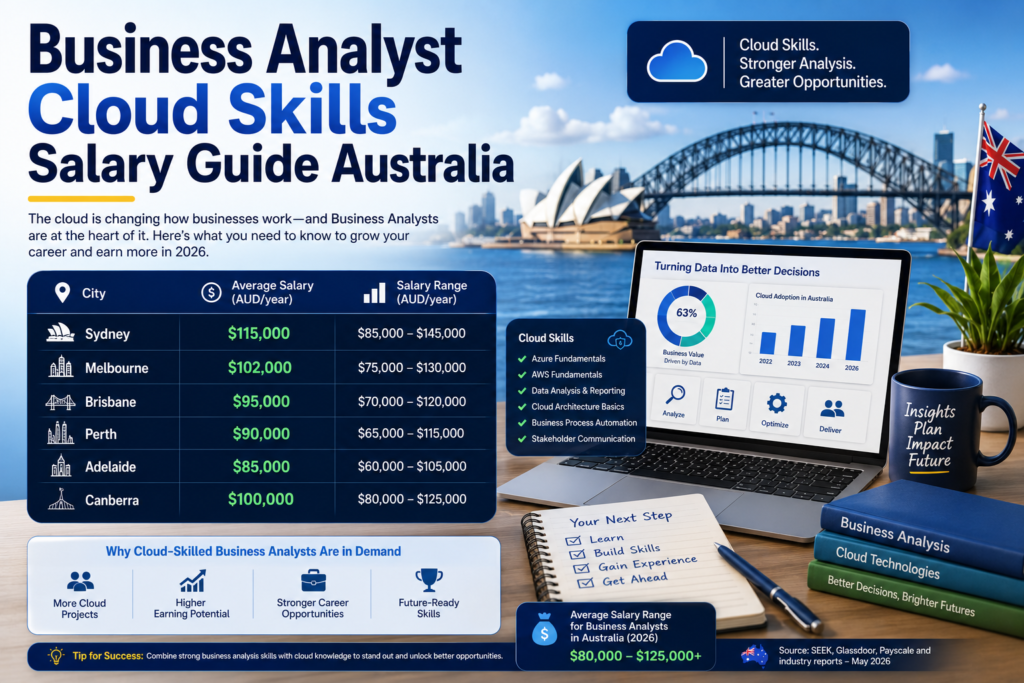
Business Analyst Salary by City
Business analyst salary in Australia is not uniform across the country Sydney and Melbourne consistently pay the highest base salaries, driven by financial services, government, and technology sector demand, while Brisbane, Perth, Adelaide, and Canberra offer strong but slightly lower ranges, often balanced out by a lower cost of living.
- Sydney: $110,000-$135,000, with senior BAs in banking and insurance pushing past $150,000.
- Melbourne: $105,000-$125,000 for permanent roles, with senior contractors earning $900-$1,100 per day.
- Brisbane: $95,000-$115,000, with strong demand from government and infrastructure projects.
- Perth: $100,000-$120,000, driven by mining, resources, and energy sector digital projects.
- Adelaide: $90,000-$110,000, with growing demand in defence and health technology.
- Canberra: $100,000-$130,000, underpinned by consistent government and public-sector BA demand.
Skills That Drive a Higher Business Analyst Salary in Australia
The biggest differentiator in Business Analyst salary Australia in 2026 is no longer just years of experience it’s the breadth of practical skills a candidate can demonstrate. Employers are consistently screening for:

- Requirements gathering and documentation — running workshops, writing user stories, and producing clear business requirement documents.
- Stakeholder management — translating between technical teams and business leadership.
- Process mapping and modelling — using tools like BPMN, Visio, or Lucidchart to map current and future-state processes.
- Agile and Scrum fluency — writing backlogs, running sprint ceremonies, and working as a proxy product owner.
- Data analysis — basic SQL, Excel modelling, and dashboarding in Power BI or Tableau.
- AI-assisted BA tools — using AI tools to draft user stories, summarise stakeholder interviews, and speed up documentation. Employers are increasingly paying a premium for this productivity edge.
Best Business Analyst Certifications in Australia (2026 Cost Guide)
Certifications won’t replace real project experience, but they do shorten the time it takes to get hired, particularly for career changers moving into their first BA role. Here’s how the major Business Analyst certifications compare on cost in 2026:
| Certification | Issuing Body | Best For | Approx. Cost (AUD) |
| ECBA (Entry Certificate in Business Analysis) | IIBA | New BAs, career changers | $450-$560 |
| CCBA (Certification of Capability in BA) | IIBA | 2-5 years’ experience | $550-$650 |
| CBAP (Certified Business Analysis Professional) | IIBA | Senior BAs, 7,500+ hrs experience | $700-$900 |
| PMI-PBA (Professional in Business Analysis) | PMI | BAs working inside project delivery | $600-$800 |
| AgileBA Foundation | APMG/BCS | Agile/Scrum-based BA roles | $700-$900 |
| BCS Business Analysis Foundation | BCS | UK/AU corporate & government roles | $650-$850 |
ECBA is issued by the International Institute of Business Analysis (IIBA) and requires no prior BA experience, making it the fastest entry point for career changers. CBAP, by contrast, requires 7,500 hours of documented BA experience and is widely regarded as the industry gold standard in banking, insurance, and telecommunications.
PMI-PBA, issued by the Project Management Institute (PMI), is a strong alternative where BA work sits inside formal project delivery — common in consulting, defence, and PMO-led organisations. AgileBA, accredited by APMG, is worth prioritising if you’re targeting Agile/Scrum-heavy employers, which now make up a large share of BA job ads in Sydney and Melbourne.
If you’re weighing which certification fits your stage of career, businessanalystcourse.au runs certification-aligned Business Analyst training across Australia, including the Fast Start in Business Analysis course for beginners, the Agile Business Analyst (AgileBA) Foundation course, and the BCS Business Analysis Foundation course.
How to Become a Business Analyst in Australia (Fastest Path)
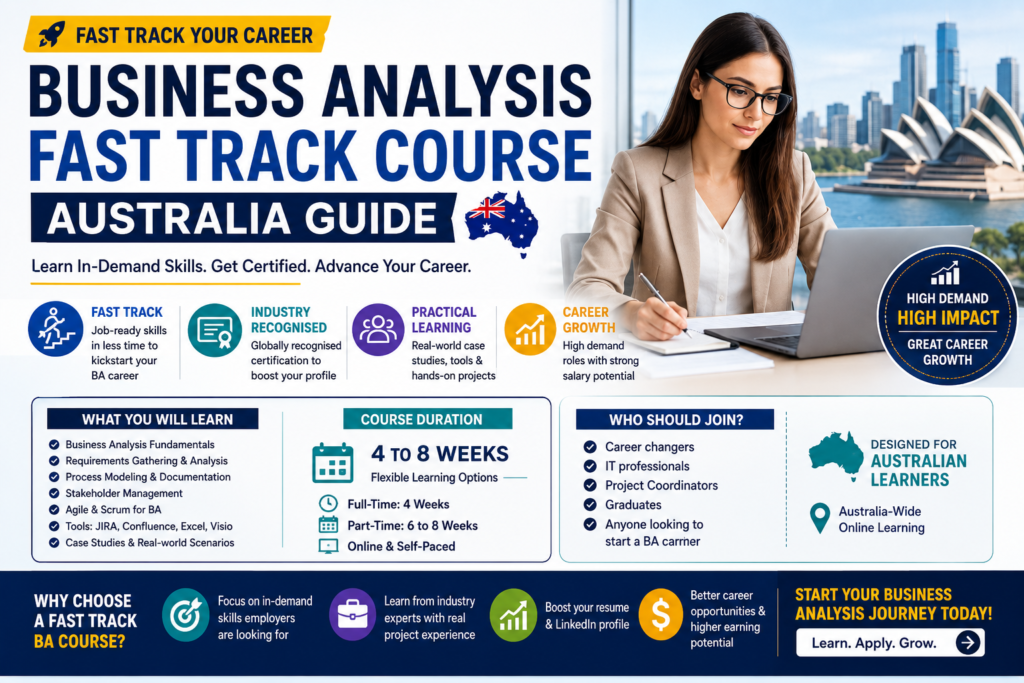
If you’re changing careers into business analysis, the fastest realistic path in 2026 looks like this:
- 1. Build foundational knowledge through a structured course covering requirements gathering, stakeholder management, and process modelling.
- 2. Earn an entry-level certification such as ECBA to demonstrate commitment and baseline knowledge to employers.
- 3. Build a portfolio of sample business requirement documents, process maps, and user stories from course projects or volunteer work.
- 4. Target junior or BA-adjacent roles such as Business Support Analyst or Project Coordinator to gain real project hours.
- 5. Progress toward CCBA or CBAP once you have several years of documented BA experience, unlocking senior salary brackets.
Career changers moving from support, admin, or operations roles into business analysis in Australia typically see an immediate salary jump of $20,000-$30,000, with further increases as certifications and project experience build up.
Business Analyst vs. Related Roles: Salary Comparison
- Business Analyst: $105,000-$125,000 average — focuses on requirements, process improvement, and stakeholder alignment.
- Business Analyst, IT: $80,000-$130,000 — leans more technical, bridging business needs with IT systems and development teams.
- Product Owner: $120,000-$150,000 — a common next step for BAs working in Agile/Scrum environments.
- Senior/Lead Business Analyst: $150,000-$165,000+ — typically requires CBAP or PMI-PBA plus 7+ years’ experience.
Where to Study Business Analysis in Australia
Business Analyst training is available online nationwide and in person across major Australian cities. businessanalystcourse.au offers certification-aligned courses in Sydney, Melbourne, Brisbane, Perth, Adelaide, and Canberra, with flexible weekday, evening, weekend, and live virtual class options. Browse the full course catalogue or get in touch to find the right training path for your experience level.
Final Thoughts
Business Analyst salary in Australia in 2026 rewards a specific combination: practical requirements-gathering skills, stakeholder management ability, familiarity with Agile delivery, and — increasingly comfort using AI tools to speed up documentation. Pairing real project experience with the right certification (ECBA to start, CBAP or PMI-PBA once you’re senior) remains the clearest way to move from an entry-level salary toward the $150,000+ bracket.
Ready to get started? Explore Business Analyst courses in Australia or enquire now to find the right training path for you.