


Business analyst interview questions Australia have become more practical, scenario-based, and skill-focused than ever, as hiring managers raise the bar for candidates across banking, government, healthcare, and technology. Whether you’re a fresher entering the field or an experienced professional moving into a new BA role, preparing the right business analyst interview questions and answers can significantly improve your chances in a competitive 2026 hiring market.
Looking to improve your business analyst skills and prepare for your next interview? We support learners and professionals in Sydney, Melbourne, Brisbane, Perth, Adelaide, Canberra, Gold Coast, Hobart, Darwin, and across Australia. Call our training team on 1800 159 151 to find the right business analyst course for your career goals.
Business Analyst Interview Questions Australia by Category
| Category | What It Tests | Example Question |
| Core BA Skills | Requirements gathering, documentation, prioritisation | How do you gather requirements from stakeholders? |
| Technical Skills | SQL, process modelling, tools (Jira, Visio, Power BI) | What’s the difference between a BRD and an SRS? |
| Agile & Scrum | Backlog management, ceremonies, user stories | How do you write a good user story? |
| Behavioural / STAR | Communication, conflict resolution, stakeholder management | Tell me about a time you managed conflicting requirements. |
| Scenario / Case Study | Applied judgement under ambiguity | How would you scope a project with unclear objectives? |
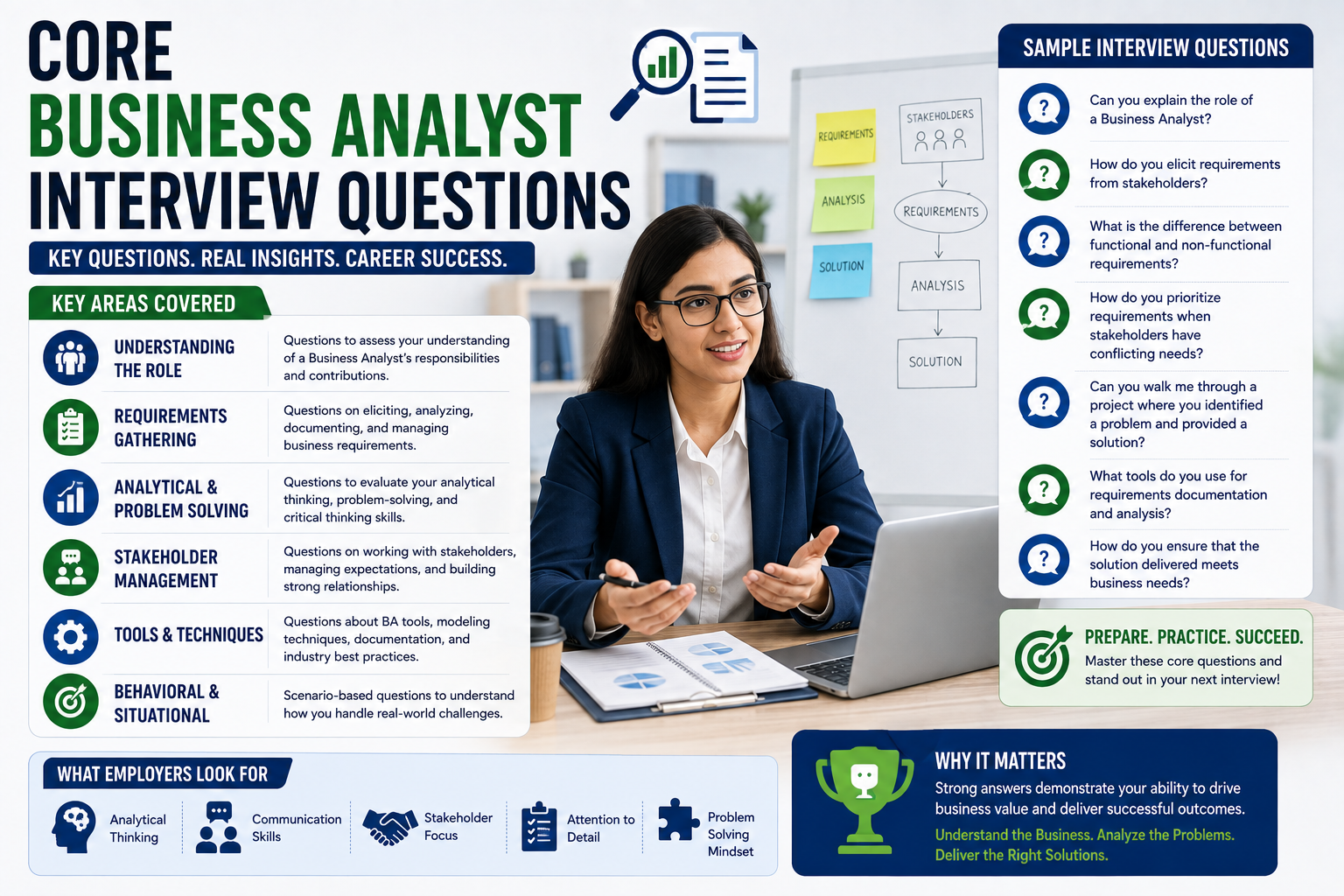
Core Business Analyst Interview Questions
- What does a Business Analyst do?
A Business Analyst acts as a bridge between business stakeholders and technical delivery teams, identifying business needs and recommending solutions that improve efficiency and productivity. Strong answers mention requirements gathering, process mapping, stakeholder management, and ensuring delivered solutions align with business objectives.
For a formal definition of the discipline, see the International Institute of Business Analysis (IIBA) overview, and check SEEK’s current Business Analyst salary data to benchmark expectations before your interview.
- What is the difference between a BRD, FRD, and SRS?
A Business Requirements Document (BRD) captures high-level business needs and objectives. A Functional Requirements Document (FRD) breaks those needs into specific system functions. A Software Requirements Specification (SRS) provides detailed technical requirements for developers. Interviewers want to see you understand when each document is used and who the audience is for each.
- What techniques do you use for requirements gathering?
Strong answers reference multiple techniques depending on the project stakeholder interviews, workshops, surveys, document analysis, observation, and prototyping. Explain how you choose the right technique based on stakeholder availability, project complexity, and the type of requirement being captured.
- What is the difference between functional and non-functional requirements?
Functional requirements describe what a system should do, such as allowing users to log in or place an order. Non-functional requirements describe how the system should perform, such as load time, security standards, or scalability.
- How do you prioritise requirements when stakeholders disagree?
Reference a structured framework such as MoSCoW (Must have, Should have, Could have, Won’t have) prioritisation, and explain how you balance business value, technical feasibility, and stakeholder influence to reach agreement without simply deferring to the loudest voice in the room.
Technical Business Analyst Interview Questions
- What tools do you use as a Business Analyst?
Be specific about the tools you use – Microsoft Excel and Power BI for data analysis and visualisation, Visio or Lucidchart for process modelling, Jira or Azure DevOps for backlog management, and SQL for querying databases. Tailor your answer to tools mentioned in the job description where possible.
- Can you explain a JOIN in SQL?
SQL is the most commonly tested technical skill in Business Analyst interviews. Be ready to explain INNER JOIN, LEFT JOIN, and how GROUP BY and window functions are used to summarise data – even a basic working knowledge signals you can engage directly with data rather than relying entirely on developers or analysts.
- What is gap analysis and when do you use it?
Gap analysis compares the current state of a business process or system against the desired future state, identifying what needs to change to close the gap. It’s commonly used early in a project to justify why a change is needed and to scope the work required.
- What’s the difference between verification and validation?
Verification checks whether the product was built correctly according to documented requirements and specifications – “are we building the product right?” Validation checks whether the delivered solution actually meets business needs and user expectations – “are we building the right product?”
Agile and Scrum Business Analyst Interview Questions
- How do you write a good user story?
Reference the standard format – “As a [user], I want [goal], so that [benefit]” – and explain how you attach clear acceptance criteria to each story so the development team knows exactly when it’s considered complete. Mention using the INVEST criteria (Independent, Negotiable, Valuable, Estimable, Small, Testable) if relevant to the role.
- What is the difference between Agile and Waterfall?
Waterfall follows a sequential, plan-driven approach where each phase completes before the next begins, suited to projects with fixed, well-understood requirements. Agile uses iterative, change-driven cycles (sprints) that allow requirements to evolve as the project progresses, suited to projects where flexibility and rapid feedback matter more than upfront certainty.
- What is your role as a BA during Scrum ceremonies?
Explain your involvement in backlog refinement, sprint planning, daily stand-ups, sprint reviews, and retrospectives – many Australian employers expect BAs to act as a proxy product owner on smaller teams, so be ready to describe how you prioritise and clarify backlog items between the business and the development team.
Behavioural Business Analyst Interview Questions (STAR Method)
- Tell me about a time you managed conflicting stakeholder requirements.
Use the STAR method (Situation, Task, Action, Result) to structure your answer. Describe a specific situation with genuinely competing priorities, the action you took to find common ground or escalate appropriately, and a measurable result – always connect the story back to a business outcome, not just a resolved disagreement.
- Describe a time a project’s requirements changed significantly. How did you handle it?
Interviewers want to see adaptability without losing control of scope. Explain how you assessed the impact of the change, communicated it to relevant stakeholders, and updated documentation or the backlog accordingly, rather than simply absorbing scope creep.
- How do you handle a stakeholder who is difficult to engage or unresponsive?
This tests communication, persistence, and diplomacy. Reference specific tactics – shorter, more targeted questions; scheduling brief check-ins instead of long workshops; or looping in a sponsor when engagement genuinely blocks progress – while keeping the tone professional rather than critical of the stakeholder.
Scenario and Case-Study Business Analyst Interview Questions
- How would you approach a project with an unclear or ambiguous scope?
Strong answers describe a systematic approach: clarifying the business problem before jumping to solutions, running discovery workshops with key stakeholders, documenting assumptions explicitly, and proposing a phased or iterative approach rather than committing to a fixed scope prematurely.
- Walk me through how you’d analyse a large, unfamiliar dataset for a new project.
Reference a structured process – understanding the business question first, profiling the data for quality issues, identifying key variables and relationships, and validating findings with subject matter experts before presenting conclusions to stakeholders.
- How is AI changing the way Business Analysts work in 2026?
Increasingly common in 2026 interviews. Strong answers acknowledge that AI tools now assist with drafting user stories, summarising stakeholder interviews, and analysing large datasets faster, while emphasising that judgement, stakeholder relationships, and business context – the parts of the role AI can’t replace – remain the core value a BA brings.
2026 Business Analyst Salary Expectations in Australia
Knowing current salary bands helps you negotiate confidently if the topic comes up. In 2026, entry-level Business Analysts in Australia typically earn $70,000-$90,000, mid-level BAs with a few years of experience sit around $90,000-$125,000, and senior Business Analysts commonly reach $125,000-$150,000 or more depending on industry and location banking, government, and technology consistently pay at the top end of these ranges in Sydney and Melbourne.
How to Prepare for a Business Analyst Interview in Australia
- Research the company and role, including recent projects, industry challenges, and the specific tools listed in the job description.
- Practice the STAR method for every behavioural question so your answers stay structured under pressure.
- Prepare two or three strong project examples you can adapt across multiple questions – requirements gathering, stakeholder conflict, and a technical challenge.
- Refresh core frameworks – MoSCoW prioritisation, BRD vs FRD vs SRS, and Agile vs Waterfall – since these come up in almost every BA interview.
- Brush up on SQL basics even for less technical BA roles, since it remains the most commonly tested technical skill.
Where to Build Business Analyst Skills Before Your Interview
If your interview preparation has revealed gaps in core BA skills, structured training can close them faster than self-study alone. businessanalystcourse.au runs certification-aligned Business Analyst training across Australia, including the Fast Start in Business Analysis course for career changers, the Agile Business Analyst (AgileBA) Foundation course for Scrum-heavy roles, and the BCS Business Analysis Foundation course, with training available in Sydney, Melbourne, Brisbane, Perth, Adelaide, and Canberra. Browse the full course catalogue or get in touch to find the right training path before your next interview.
Final Thoughts
Business analyst interview questions in Australia in 2026 reward candidates who can move fluidly between core BA fundamentals, technical tools, Agile delivery, and clear behavioural storytelling – not just those who have memorised definitions. Practise the STAR method for behavioural questions, keep two or three strong project examples ready to adapt, and make sure your core frameworks (MoSCoW, BRD vs FRD vs SRS, Agile vs Waterfall) are second nature before you walk in. Preparation across all five categories in this guide is the clearest way to walk into your next interview with confidence.
Want to close your skill gaps before your next interview? Explore Business Analyst courses in Australia or enquire now to find the right training path for you.