
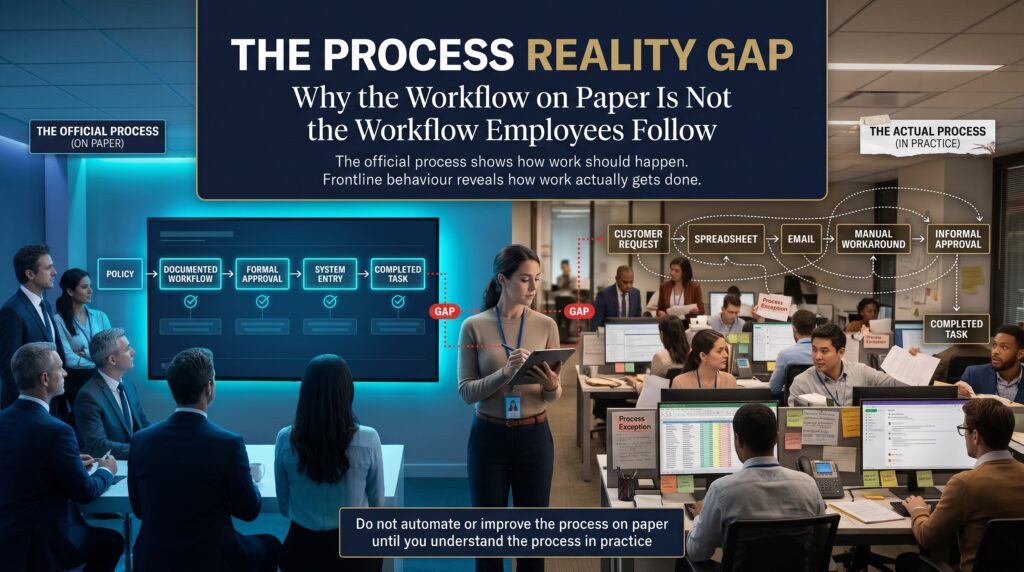


The process reality gap is the distance between how a business says work gets done and how it actually gets done. On paper, an invoice moves neatly from request to approval to payment. In reality, it travels through a personal inbox, a text message to a manager, a spreadsheet nobody else knows about, and a quick favour from someone in finance. The diagram in the policy folder is tidy. The real workflow is not.
Every organisation has a process reality gap, and most leaders only discover theirs when something expensive goes wrong: a failed system rollout, an audit finding, a customer complaint that no one can trace. This guide explains why the gap forms, what it costs, how business analysts find it, and how to close it. It is written for business analysts, project managers, operations leads and anyone who has ever been handed a process map and thought, “nobody actually works like this.”
What Is the Process Reality Gap?
The process reality gap is the difference between the documented process and the process employees really follow. The documented version lives in manuals, flowcharts, standard operating procedures and training slides. The real version lives in people’s habits, shortcuts, workarounds and informal agreements.
Safety researchers describe the same idea as the difference between work-as-imagined and work-as-done. Managers imagine how work should go. Employees do the work in a world of deadlines, broken tools, missing information and exceptions. The two are never identical, and the space between them is where problems grow.
It is important to say what the process reality gap is not. It is not proof that employees are careless or rebellious. In most cases, people deviate from the paper process because the paper process does not fit the job. A workaround is usually a signal that someone solved a problem the official process ignored.
Why the Workflow on Paper Is Not the Workflow Employees Follow

The process reality gap rarely appears overnight. It builds slowly, for several connected reasons.
The process was designed by people who do not do the work
Processes are often drawn up by managers, consultants or project teams working from interviews and assumptions. They capture the happy path, the version where nothing goes wrong. The people doing the work deal with the other ninety percent of reality: missing approvals, unusual customers, system outages and half-complete data.
Exceptions are never documented
Real processes are full of “except when” rules. Except when the customer is a key account. Except when the manager is away. Except when the system times out. Because these cases feel too messy to draw, they stay in people’s heads, and the process reality gap quietly widens.
Tools do not match the process
When a system forces five clicks for a task people do fifty times a day, they find a faster way. Spreadsheets, shared drives, chat groups and personal templates appear. These shadow processes work, but they sit outside the official workflow, and nobody manages them.
Changes pile up without the documentation changing
A new regulation, a team restructure, a tool upgrade. Each one changes how work flows, yet the written process stays the same because updating it is nobody’s priority. Over time the document describes a business that no longer exists.
Pressure rewards speed over compliance
If targets reward throughput and nobody checks the steps, people take the shortest route. Training also plays a part. New starters learn from the person beside them, not from the manual, so the real process spreads by word of mouth and the process reality gap passes from one generation of staff to the next.
| On-paper step | What often happens in practice | Risk created |
| Submit request through the portal | Request arrives by email or chat because the portal is slow | No audit trail, requests get lost |
| Manager approves in the system | Approval given verbally or by text, entered later or never | Compliance gap, unclear accountability |
| Finance validates against policy | Finance relies on a personal spreadsheet to check exceptions | Single point of failure, inconsistent decisions |
| Payment released automatically | Urgent items are pushed through manually | Duplicate or incorrect payments |
| Reporting from system data | Reports rebuilt by hand because data is incomplete | Leaders make decisions on unreliable numbers |
This table is an illustration, not a case study, but almost every analyst who has mapped a real process will recognise the pattern.
What the Process Reality Gap Costs Your Business
The cost of the process reality gap rarely shows up as one line item. It leaks out in several places at once.
- Failed projects. A new system built around the documented process cannot handle the real one. Users reject it, build workarounds on top of it, and the project is declared late or over budget.
- Automation that automates fiction. Robotic process automation and workflow tools copy whatever process they are given. Automate the paper version and you speed up something nobody actually does.
- Compliance and audit risk. When the real workflow skips a documented control, the organisation is exposed even though the policy looks perfect.
- Slow onboarding. New employees receive one version in training and discover another on the job.
- Bad data. Information captured outside official systems never reaches reports, so decisions rest on partial pictures.
- Hidden dependency on individuals. If the only person who understands the real process leaves, the process leaves with them.
How Business Analysts Find the Process Reality Gap
Finding the gap is a core business analysis skill. The aim is to see the as-is process as it truly runs, not as people describe it in a meeting room. Strong analysts combine several methods, because each one catches something the others miss.
| Method | What it reveals | Watch out for |
| Observation and job shadowing | What people really do, including steps they forget to mention | People may behave differently when watched |
| One-to-one interviews | Reasons behind workarounds, tacit knowledge | People describe the ideal, not the real |
| Walkthrough with real examples | Where actual cases diverge from the standard path | Needs genuine recent cases, not made-up ones |
| Document and artefact review | Forms, templates, spreadsheets and emails in use | Documents show outputs, not decisions |
| Process mining and system data | Actual paths, delays and rework from event logs | Only captures what happens inside systems |
| Workshops with front-line staff | Shared view of pain points and exceptions | Dominant voices can hide minority views |
A useful habit is to ask for the last three real cases instead of asking “how does it work?”. Cases expose the exceptions that general descriptions smooth over. The BABOK Guide from IIBA describes many of these elicitation and analysis techniques, and the Business Process Model and Notation standard gives teams a common language for drawing what they find. The lean tradition of “go and see”, promoted by the Lean Enterprise Institute, reinforces the same lesson: you cannot understand a process from your desk.
How to Close the Process Reality Gap in 6 Steps
- Map the as-is process from reality. Use observation, real cases and system data to draw the workflow people actually follow, including exceptions and workarounds. A swimlane diagram or BPMN model works well.
- Place the documented process beside it. Lay the paper version and the real version side by side. Every difference is a finding, and each one needs a question rather than a blame.
- Ask why each difference exists. Is it a missing tool, an unclear rule, a pressure from targets, or a genuine improvement? Some workarounds are better than the official step.
- Decide what to change. Choose between fixing the process, fixing the tool, retraining people, or updating the documentation to match a better reality. Not every gap should be closed by forcing people back to the old way.
- Validate with the front line. Take the to-be design back to the people who do the work. If they say “that would never survive a busy Monday”, believe them and adjust.
- Assign an owner and a review rhythm. A process without an owner drifts. Give each key workflow a named owner and a regular review, so the process reality gap does not quietly reopen.
Notice that the first step is discovery, not design. Many failed improvement projects skip it and start drawing the future state from the paper process, which only repeats the original mistake.
Building the Skills to See the Process Reality Gap
Spotting and closing the gap is a learnable skill. Business analysis training teaches elicitation, process modelling, requirements analysis and stakeholder communication, the exact toolkit needed here. If you are building those skills, start with the range of business analyst courses. The Business Analysis Techniques course focuses on practical methods for analysing and improving processes, and the Business Analysis Practice Practitioner course is aimed at applying techniques in real work. If you are new to the field, Fast Start in Business Analysis is a sensible starting point. For recognised qualifications, look at the BCS Business Analysis Foundation and the Agile Business Analyst (AgileBA) Foundation. Technology-minded analysts may also like AWS Business Essentials, and the BCS qualification body publishes information about its business analysis certifications.
You can see the wider catalogue at Logitrain business analysis training courses, read more on our about us page, or browse the business analyst blog for related guides. Our sister site, Business Analyst Courses, also publishes career and technique articles.
The Process Reality Gap Across Australian Cities
The size and shape of the process reality gap changes with the industry. Here is where analysts in each major city tend to meet it. Classes run in person in Melbourne, Sydney and Brisbane, and live online or in-house elsewhere.
| City | Where the gap tends to show up | Local course page |
| Sydney | Financial services and insurance, where approval chains and compliance steps are heavy | Business analyst course Sydney |
| Melbourne | Health, education, telcos and large service organisations with many handoffs | Business analyst course Melbourne |
| Brisbane | Government and infrastructure projects with long procurement and approval flows | Business analyst course Brisbane |
| Perth | Mining and energy operations where field practice and head-office process often diverge | Business analyst course Perth |
| Adelaide | Defence, health and manufacturing, with detailed procedures and tight controls | Business analyst course Adelaide |
| Canberra | Federal agencies where policy-heavy processes meet real-world delivery pressure | Business analyst course Canberra |
Frequently Asked Questions About the Process Reality Gap
What is a process reality gap?
It is the difference between the process an organisation documents and the process its employees actually follow. The gap usually comes from exceptions, workarounds, tool limitations and changes that were never written down.
What is the difference between a documented process and an actual process?
A documented process is the official description in manuals, flowcharts and procedures. The actual process is what happens day to day, including shortcuts and informal steps. Business analysts compare the two to find risks and improvement opportunities.
How do you find out how work is really done?
Combine observation, interviews, real case walkthroughs, document review and, where available, process mining. Asking people to walk through their last few real cases is far more reliable than asking how the process works in general.
Why do system implementations fail because of the process reality gap?
Systems are configured around the documented process. If the real process differs, users cannot do their jobs in the new system, so they build workarounds and adoption suffers.
Is closing the process reality gap always about enforcing the documented process?
No. Sometimes the workaround is better than the official step, and the right move is to update the process and the documentation. The aim is a process that is accurate, workable and owned.
Close the Gap Before It Costs You
The process reality gap is not a sign that your people are failing. It is a sign that the way work really happens has moved away from the way it is written down. Look at the real workflow first, ask why it differs, and design from truth instead of assumption, and projects get cheaper, systems get adopted and controls start to work. If you want to learn how to do that professionally, explore our business analyst courses or contact our team on 1300 649 299.