
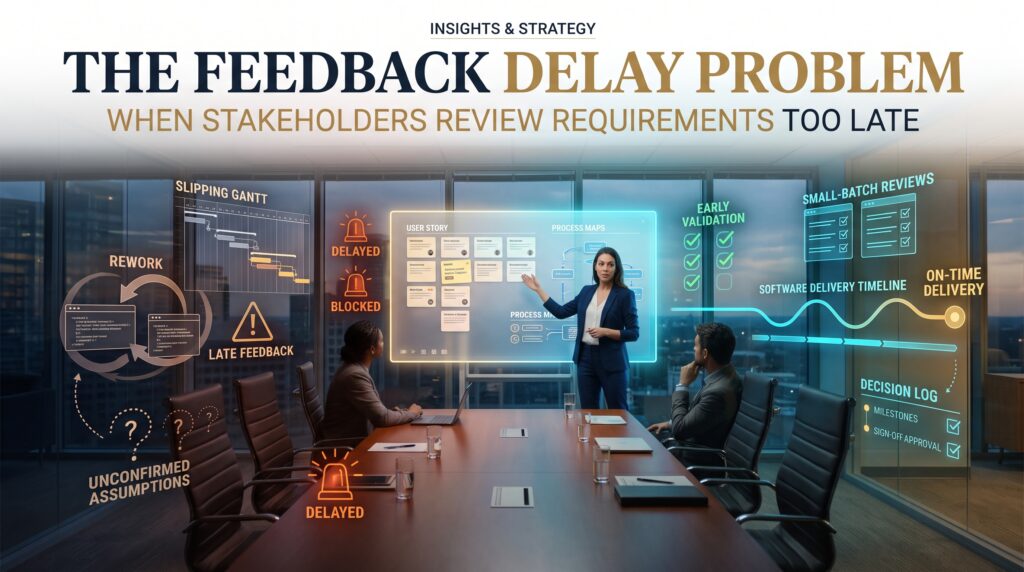


A requirements review is supposed to be the moment a project checks its own thinking. Business analysts write down what the organisation needs, stakeholders read it, and anything wrong gets fixed while it is still cheap to fix. In practice, the review often happens far too late: after the design is drawn, after developers have started building, sometimes only after the first demo. By then, every correction feels like a crisis.
This is the feedback delay problem. It is one of the most common and most expensive patterns in project delivery, and it is rarely anyone’s fault. In this guide, we explain why stakeholders review requirements too late, what the delay really costs, and the practical techniques business analysts use to bring feedback forward, whether you work in Sydney, Melbourne, Brisbane, Perth, Adelaide or Canberra.
What Is the Feedback Delay Problem?
The feedback delay problem happens when the people who understand the business need see the requirements only after major work has been built on top of them. The gap between writing a requirement and getting meaningful feedback on it keeps stretching, and every day of delay adds more work that depends on an unchecked assumption.
A healthy requirements review is not a single sign-off meeting at the end. It is a series of small, early checks that confirm the team understands the problem, the scope and the expected outcome. When that rhythm breaks, errors travel quietly through analysis, design, build and testing before anyone catches them.
Why Stakeholders Review Requirements Too Late

Their calendars are already full
Senior stakeholders carry operational responsibilities that never pause for a project. A forty-page document lands in their inbox with a request for comments by Friday, and it sinks beneath more urgent work. Review becomes something they intend to do rather than something they do.
Requirements documents are hard to read
Dense text, unfamiliar notation and long lists of ‘shall’ statements make it difficult for a busy person to imagine how the future process will actually feel. Without something concrete to react to, stakeholders skim, nod and approve, then discover the problem later when the real thing appears.
Nobody owns the review
When a requirements review has no named reviewer, no deadline and no definition of done, it drifts. Everyone assumes someone else has checked the detail that sits in their area.
The business does not feel the cost yet
Early in a project, nothing is visibly at stake. Stakeholders tend to engage when they can see screens, reports or workflows, which usually happens well after the requirements were written. By that point the right time for easy feedback has already passed.
Review is treated as a gate, not a conversation
Many teams schedule one formal sign-off at the end of the requirements phase. A single gate encourages people to wait and review everything at once, which is exactly when the volume is highest and the appetite for change is lowest.
Teams fear slowing things down
Analysts sometimes avoid asking for early feedback because the schedule is tight and they do not want to look unfinished. Ironically, that hesitation is what produces the biggest delays later.
The Real Cost of a Late Requirements Review
It is a long-established finding in software and systems engineering that the later a defect is found, the more it costs to correct. A misunderstanding caught in a conversation takes minutes. The same misunderstanding caught after build can take weeks, because designs, code, test cases, training material and data migration may all need to change. A delayed requirements review pushes that discovery to the most expensive moment.
- Teams redo work that was built correctly against the wrong requirement.
- Scope disputes. Late changes are often labelled ‘scope creep’, even when they are really missed requirements.
- Budget and schedule blowouts. Corrections consume contingency that was meant for real risks.
- Lost trust. Stakeholders feel surprised, and the delivery team feels blamed.
- Weaker outcomes. Under pressure, teams ship a compromise instead of the solution the business needed.
Warning Signs Your Requirements Review Is Happening Too Late
- Stakeholders first raise major concerns during user acceptance testing or the first demo.
- Requirements are ‘approved’ with no comments, then challenged weeks later.
- The same people who were silent during analysis become vocal during build.
- Change requests cluster at the end of the project.
- Review comments arrive as a pile in the final week rather than a steady flow.
- Nobody can say who reviewed which requirement, or when.
| Early requirements review | Late requirements review |
| Happens while ideas are still forming | Happens after design and build have started |
| Stakeholders react to visuals, examples and small slices | Stakeholders skim long documents and approve under pressure |
| Feedback is a conversation, with questions answered quickly | Feedback is a list of objections, often with no time to respond |
| Corrections take minutes or hours | Corrections take days or weeks and touch many deliverables |
| Builds trust and shared understanding | Creates surprise, blame and defensive behaviour |
How to Fix the Feedback Delay Problem
1. Plan the requirements review before you write
Agree at the start who will review what, when and how. Put review dates in the project plan and book the sessions in advance. Treat reviewer time as a project dependency, not a favour.
2. Review in small slices
Share a one-page process map or three user stories this week rather than a forty-page document next month. Smaller pieces are easier to read, easier to discuss and far less likely to be ignored.
3. Use visuals and prototypes
Process models, wireframes, mock reports and simple prototypes give stakeholders something concrete to react to. People who struggle to critique a paragraph will quickly tell you a screen is missing a field.
4. Run walkthroughs instead of sending attachments
A thirty-minute walkthrough, where the analyst talks through the requirement and invites questions, usually produces better feedback than a week of silent reading. Record decisions and actions in the meeting itself.
5. Name reviewers and set deadlines
Use a simple responsibility matrix such as RACI so every requirement has a clear reviewer and approver. State the review deadline, explain what happens if there is no response and follow up early.
6. Define what a good requirements review looks at
Give reviewers a short checklist so they know what to look for. The BABOK Guide from IIBA describes quality characteristics for requirements, such as being clear, consistent, complete, testable and feasible.
7. Track every comment and close the loop
Log each piece of feedback, record the decision and tell the reviewer what changed. People review more willingly when they see that their input matters.
8. Borrow the feedback rhythm from agile
The Agile Manifesto and the Scrum Guide both build frequent feedback into the way teams work, through backlog refinement and sprint reviews. Even teams that follow a traditional approach can adopt the same habit of showing work early and often. For practical background, see the Atlassian agile guides.
Requirements Review Techniques Business Analysts Use
| Technique | Best used for |
| Walkthrough | Explaining a requirement, process or model and gathering fast reactions |
| Peer review | Catching gaps and ambiguity before stakeholders see the material |
| Formal inspection | High-risk or regulated requirements that need documented evidence |
| Prototype review | Confirming screens, reports and workflows with end users |
| Acceptance criteria review | Checking that each requirement can be tested using clear Given, When, Then statements |
| Traceability review | Confirming every requirement links back to a business need and forward to a test |
A Simple Requirements Review Checklist
- Is the requirement clear enough that two people would interpret it the same way?
- Does it trace back to a stated business objective?
- Is it testable, with a measurable pass or fail condition?
- Does it conflict with any other requirement or policy?
- Is it technically and operationally feasible?
- Has the right stakeholder confirmed it, and is that recorded?
What to Do When Stakeholders Will Not Review
Sometimes stakeholders simply do not respond. Rather than waiting, escalate early and politely through the project sponsor. Log the unreviewed requirements as assumptions, state the risk of proceeding and ask the sponsor to decide. Documenting the risk makes the cost of silence visible without turning it into an argument.
Building the Skills to Lead an Effective Requirements Review
Running a good requirements review is a skill that combines elicitation, facilitation, modelling and stakeholder management. It is also one of the things employers notice when they promote analysts. If you want to build these skills, our business analyst course covers requirements gathering, process mapping, stakeholder engagement and practical case studies. You can learn more about the training approach on our about page, explore related programs at businessanalysiscourses.com.au and see the wider IT and certification range at Logitrain.
Many analysts also pursue IIBA certifications such as ECBA, CCBA and CBAP to validate their knowledge. Browse current analyst roles and expectations on SEEK Career Advice to see which skills employers ask for most.
Training options are available for learners in Sydney, Melbourne, Brisbane, Perth, Adelaide and Canberra, with classroom and live online formats so you can study around your work.
Frequently Asked Questions About Requirements Review
What is a requirements review?
A requirements review is a structured check where stakeholders and the project team examine requirements to confirm they are correct, complete, clear, testable and aligned to the business need.
When should a requirements review happen?
As early and as often as possible. Review small pieces as they are drafted, then do a consolidated review before design and build rely on them.
Who should take part in a requirements review?
Business stakeholders who own the need, subject matter experts, the business analyst, technical leads and testers all add useful perspectives. Each requirement should have a named approver.
Why do stakeholders give feedback so late?
Usually because they are busy, the material is hard to read, ownership is unclear, or they only see the impact once something tangible exists. Early walkthroughs and visuals reduce all four causes.
How can a business analyst get faster feedback?
Share small slices, use visuals, hold short walkthroughs, set clear deadlines and track every comment. Escalating politely through the sponsor helps when responses stall.
Final Thoughts: Bring the Requirements Review Forward
Late feedback is rarely a people problem. It is a process problem, and a fixable one. When a requirements review becomes a regular, visual and well-owned conversation, errors surface while they are still small, and projects stop paying for the same misunderstanding twice.
If you want to lead that kind of work with confidence, explore our business analyst course options and take the next step in your business analysis career.