


A decision bottleneck is one of the most frustrating problems in project delivery, because the answer is rarely hard. A senior stakeholder could settle the question in five minutes, yet the request sits in an inbox, a meeting agenda or someone’s good intentions for three weeks. Meanwhile the team waits, guesses or quietly works on something else.
The delay is almost never about intelligence or effort. It is about how decisions are owned, packaged and routed. In this guide, we explain why a decision bottleneck forms, what it really costs, and the practical methods business analysts and project teams use to clear it, whether you work in Sydney, Melbourne, Brisbane, Perth, Adelaide or Canberra.
What Is a Decision Bottleneck in Projects?
A decision bottleneck occurs when work cannot move forward because a decision is waiting on a person, group or process that cannot respond quickly enough. Like a narrow section of pipe, it limits everything behind it. The team may be fully capable, the plan may be sound, and the budget may be approved, but throughput drops to the speed of the slowest decision.
What makes it hard to spot is that nobody is idle in an obvious way. People are busy, meetings are held and status reports are written. The waiting time hides inside the gaps between those activities.
Why Projects Wait Weeks for Answers That Take Minutes to Give

Decision rights are unclear
When nobody is sure who is allowed to decide, everyone assumes someone else will. A question travels between the project manager, the sponsor, the product owner and a steering committee, and each one forwards it politely. Unclear ownership is the most common root cause of a decision bottleneck.
One overloaded approver sits in the middle
Many organisations route every approval through a single senior person. That person is busy, the queue grows and small decisions wait behind large ones. The delay is not caused by reluctance. It is caused by arithmetic.
The question arrives without context
An email that says ‘Can we change the approval step?’ forces the decision-maker to reconstruct the background, options and consequences before answering. That effort is easy to postpone. A clear, one-page summary is much easier to approve.
Decisions only happen in meetings
If the only forum for decisions is a fortnightly steering committee, every question waits up to two weeks by design. Meetings are useful for debate, but they are a slow default channel for routine choices.
Nobody wants to own the risk
Some decisions carry visible risk, such as cost, compliance or reputation. Leaders may delay rather than be the person who chose the option that went wrong. Without a safe way to decide, the project pays in time instead.
There is no deadline and no default
When a request has no due date and no stated consequence for silence, it competes poorly with urgent work. Deadlines create priority. Defaults create movement.
The Hidden Cost of a Decision Bottleneck
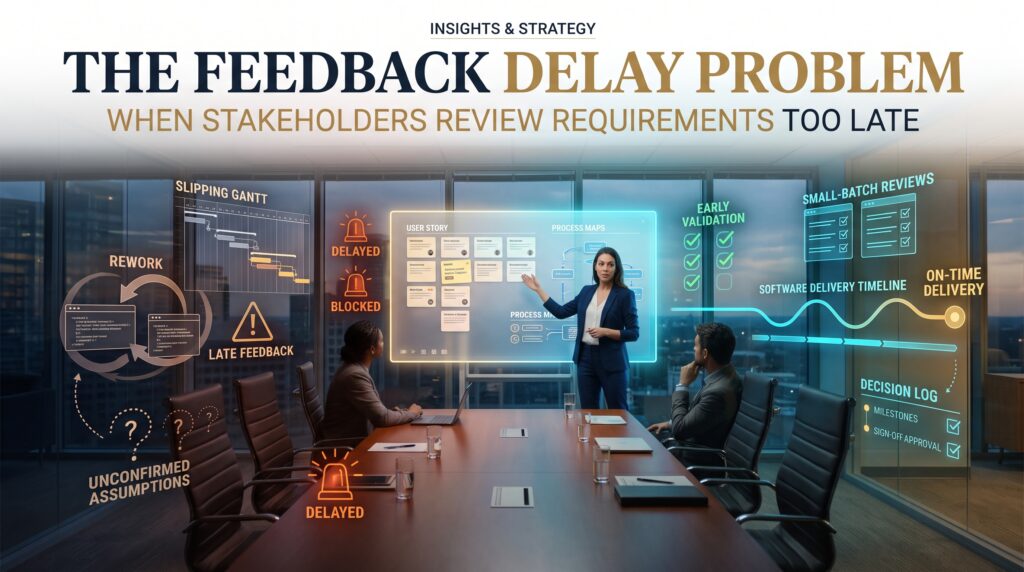
A single slow decision looks harmless on its own. Across a project, the impact compounds. Work that depends on the answer stalls, people switch to other tasks and then lose time restarting, and teams fill the gap with assumptions that may later need to be reversed.
- Idle or blocked capacity. Skilled people wait while the clock and budget keep running.
- Context switching. Moving between tasks while waiting makes each task slower and more error-prone.
- Assumption-driven rework. Teams guess so they can keep moving, then redo work when the real answer arrives.
- Schedule slippage. Small delays stack up along the critical path.
- Lower morale and trust. Teams lose confidence in leadership when simple questions go unanswered.
Warning Signs of a Decision Bottleneck
- The same question appears in several status reports without an answer.
- Team members say they are ‘waiting on approval’ more often than they say they are building.
- Decisions are revisited because nobody recorded what was agreed.
- Steering committee agendas are overloaded with routine items.
- Teams use workarounds and assumptions to avoid asking.
- Nobody can say who made a past decision or why.
Where the Decision Bottleneck Hides
| Typical decision | Why it stalls | How to unblock it |
| Requirements sign-off | Reviewers cannot see the impact of their approval | Use short walkthroughs, visuals and a clear approval deadline |
| Scope change request | Trade-offs are unclear to the sponsor | Present options with cost, time and benefit side by side |
| Priority calls between teams | No single person owns the trade-off | Assign a product owner or sponsor with authority to decide |
| Vendor or tool selection | Too many opinions and no clear criteria | Agree weighted criteria first, then score the options |
| Defect triage during testing | Decisions wait for the next scheduled meeting | Hold a short, regular triage session with the right people |
| Go-live readiness | Nobody wants to carry the risk alone | Use a shared checklist and a named accountable approver |
How to Remove a Decision Bottleneck
1. Make decisions visible with a decision log
Keep a simple log listing each open decision, the owner, the deadline and the status. Visibility alone changes behaviour, because people prefer not to be the name next to an overdue item. A log also prevents decisions being reopened later.
2. Assign clear decision rights
Use a responsibility model such as RACI or the DACI framework, which names a Driver, Approver, Contributors and Informed people for each decision. When the approver is named, the question has somewhere to go.
3. Separate big decisions from small ones
Not every choice needs the steering committee. Sort decisions by impact and reversibility. If a choice is low risk and easy to change, let the team decide and inform others afterwards. Reserve senior attention for the choices that are expensive to undo.
4. Package every decision before you ask
A good decision brief is short enough to read in two minutes. It states the question, the options, a recommendation, the impact of each choice and the date a decision is needed. Business analysts are especially well placed to write these briefs, because structuring options and trade-offs is core to the role described in the BABOK Guide.
5. Set a deadline and a default
State when you need the answer and what will happen if you do not get one. For example: ‘Unless we hear otherwise by Thursday, we will proceed with option B.’ A reasonable default keeps work moving while still giving the approver a clear chance to intervene.
6. Build a fast lane for routine decisions
Create a short, regular slot, such as a fifteen-minute decision huddle twice a week, where pending questions are settled quickly. Agile teams do something similar through backlog refinement and sprint reviews, as described in the Scrum Guide.
7. Delegate within clear limits
Give project managers, product owners and analysts authority to decide up to an agreed threshold of cost, risk or scope. Delegation removes the single-approver queue while keeping control over the big calls.
8. Escalate early and politely
If a decision is overdue, follow up once, then escalate through the sponsor with a short note explaining the impact of the delay. Escalation works best when it is predictable and framed around project outcomes, not blame.
9. Measure decision cycle time
Track how long decisions take from request to answer. Share the average with leadership. When delay becomes a visible number, it becomes easier to improve. The Project Management Institute and other professional bodies regularly highlight governance and stakeholder engagement as drivers of delivery success.
A One-Page Decision Brief Template
- Decision needed: one sentence describing the question.
- Why it matters: the impact on cost, schedule, risk or quality.
- Options: two or three realistic choices with pros and cons.
- Recommendation: the option the team prefers and why.
- Decision owner and deadline: who decides and by when.
- Default if no response: what the team will do if there is no answer.
How Business Analysts Help Clear a Decision Bottleneck
Business analysts sit between stakeholders and delivery teams, which makes them natural decision facilitators. They clarify the problem, frame options, identify who owns each choice, document the outcome and make sure it is communicated. In practice, this means writing the decision brief, running the short walkthrough, updating the decision log and following up politely until the answer arrives.
Building the Skills to Keep Projects Moving
Removing a decision bottleneck takes facilitation, stakeholder management and clear structured communication. Our business analyst course covers requirements gathering, process mapping, stakeholder engagement and practical case studies that show how to turn open questions into clear decisions. Learn more on our about page, explore related programs at businessanalysiscourses.com.au and see the wider range at Logitrain.
Many analysts also validate their knowledge with IIBA certifications such as ECBA, CCBA and CBAP. To see which skills Australian employers ask for, browse role guides on SEEK Career Advice.
Training options are available for learners in Sydney, Melbourne, Brisbane, Perth, Adelaide and Canberra, with classroom and live online formats to fit around work.
Frequently Asked Questions About the Decision Bottleneck
What is a decision bottleneck?
A decision bottleneck is a point in a project where work waits for a decision that is delayed by unclear ownership, overloaded approvers, missing context or slow approval channels.
What causes a decision bottleneck in project management?
Common causes include unclear decision rights, a single overloaded approver, poorly prepared requests, reliance on infrequent meetings, fear of accountability and the absence of deadlines.
How do you fix slow decision-making on a project?
Name decision owners, keep a decision log, package decisions in short briefs, set deadlines with defaults, delegate within limits and create a regular fast lane for routine choices.
What is the difference between RACI and DACI?
RACI assigns Responsible, Accountable, Consulted and Informed roles across tasks. DACI focuses on a specific decision and names the Driver, Approver, Contributors and Informed people.
How can a business analyst speed up decisions?
By framing options clearly, writing short decision briefs, identifying the right approver, recording outcomes and following up quickly when answers are overdue.
Final Thoughts: Clear the Decision Bottleneck, Keep the Project Moving
Most projects do not slow down because the work is difficult. They slow down because answers take too long to arrive. When decision rights are clear, questions are well packaged and deadlines come with defaults, a decision bottleneck loses its grip and the whole project speeds up.
If you want to lead that kind of change, explore our business analyst course options and take the next step in your business analysis career.