
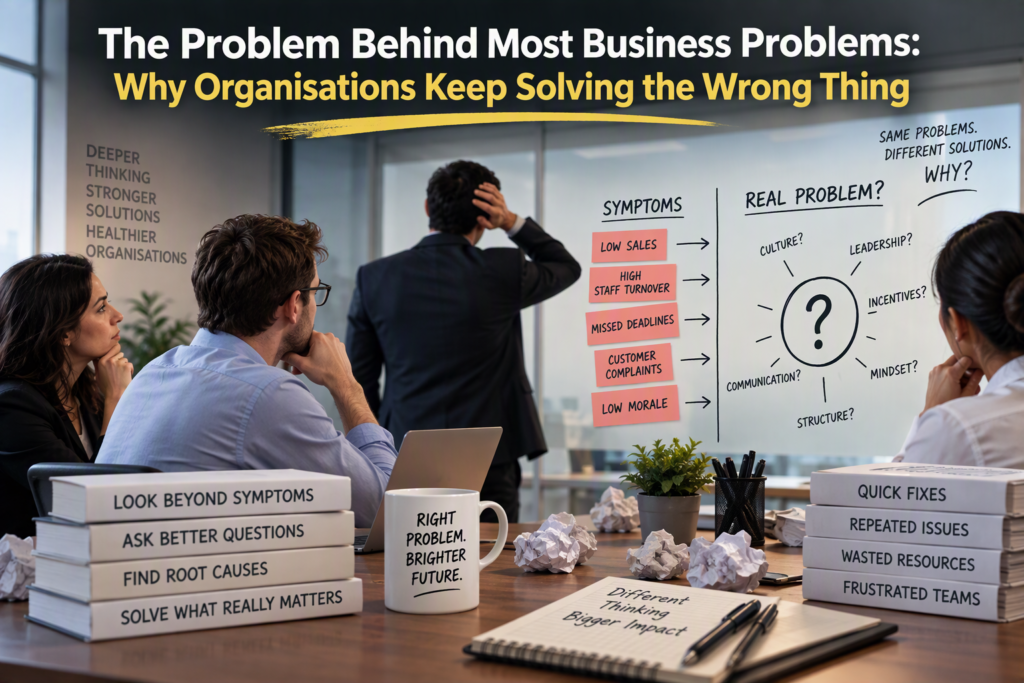



Solving the wrong problem is the quietest way an organisation can lose money. Nobody sees it happen. The project is approved, the team works hard, the solution is delivered on time and on budget, and the original pain is still there on Monday morning. Everyone did their job well. They just did it on the wrong thing.
That is the problem behind most business problems: organisations rarely lack effort or intelligence, they lack a disciplined way to decide what the problem actually is before they start fixing it. This guide explains why it keeps happening, what it costs, the six ways the wrong problem gets chosen, and the practical checks business analysts use to get it right. If you work in Sydney, Melbourne or anywhere else in Australia and have watched a good project fail to change anything, you will probably recognise the story.
What Does Solving the Wrong Problem Actually Mean?
Solving the wrong problem means putting real resources into a solution that works, but not on the issue that is actually hurting the business. Statisticians have a name for it: a Type III error, where you give the right answer to the wrong question. In everyday work it shows up as a new system nobody needed, a training program for a process that is broken, or a restructure that moves the same confusion to a different desk.
This is different from a project that fails. A failed project at least tells you something went wrong. Solving the wrong problem can look like success on every dashboard, which is exactly why it is so costly and so hard to spot.
Why Organisations Keep Solving the Wrong Problem
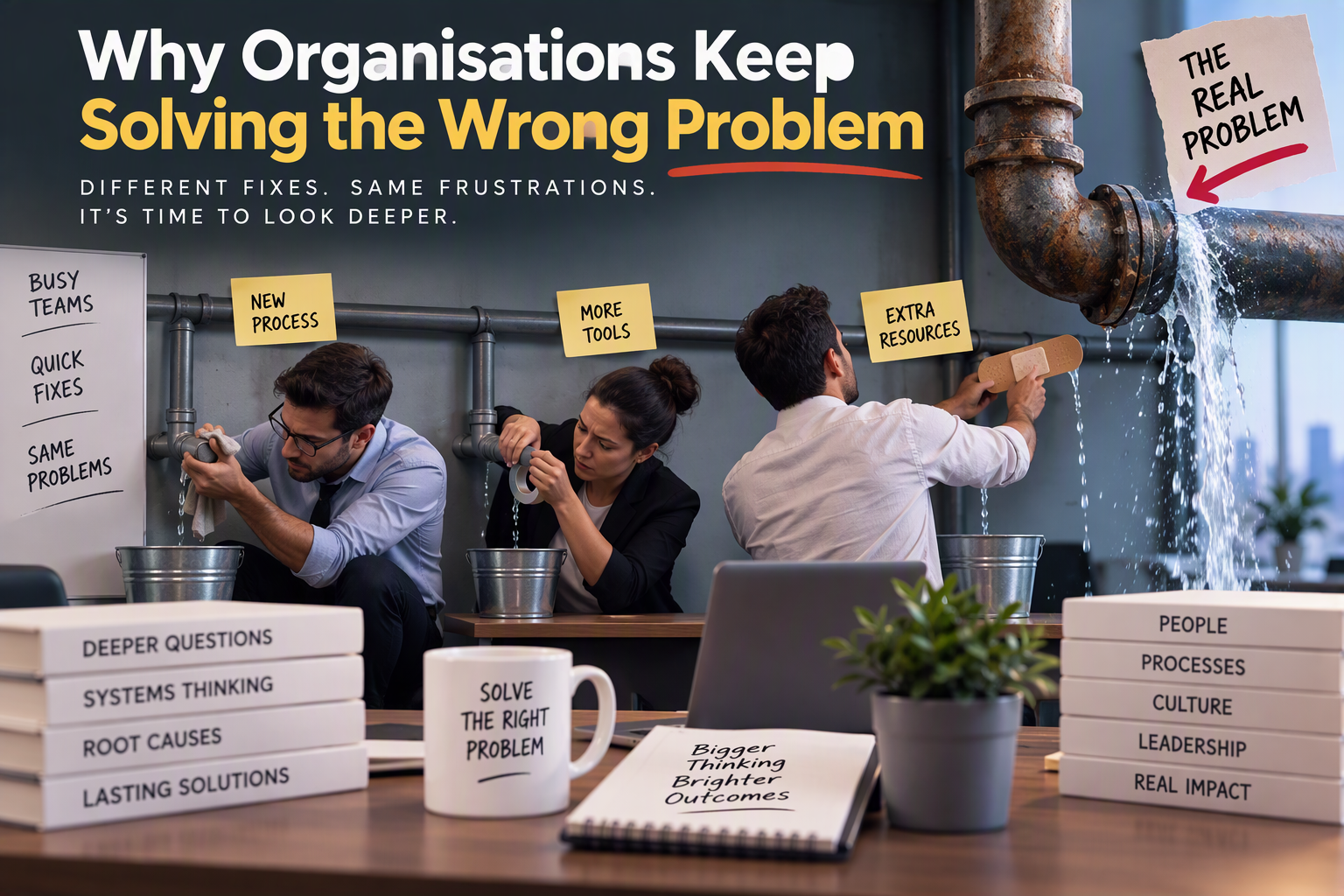
It is rarely carelessness. Usually, the structure of the organisation pushes people toward the wrong target. Here are six patterns that show up again and again.
1. The problem comes from the loudest voice
The issue that gets funded is often the one raised by the most senior or most persistent stakeholder, not the one with the most evidence behind it. Volume is mistaken for importance.
2. A solution is disguised as a problem
“We need a new CRM” sounds like a problem statement, but it is a solution. The real problem might be that sales teams cannot see customer history across channels. Once the solution is written down as the problem, every later conversation is about delivering it rather than questioning it.
3. The problem is framed too narrowly
A team optimises its own corner, such as faster invoice processing, while the actual delay sits between departments. They solve the wrong problem very efficiently, and the customer notices no difference.
4. Only one perspective is heard
IT sees a systems problem, finance sees a cost problem and operations sees a staffing problem. When a single view defines the issue, the solution inherits that view. The real cause often sits where the perspectives overlap.
5. The problem has changed, but the plan has not
Business cases are written months before delivery. By the time the solution arrives, the market, the regulation or the customer behaviour may have moved on, yet the project keeps solving yesterday’s problem because nobody asked whether it was still the right one.
6. People solve what they are measured on
If a team is rewarded for tickets closed, it will close tickets. If another is rewarded for staying under budget, it will cut corners that create problems elsewhere. Incentives quietly define the problem long before anyone writes a brief.
The Real Cost of Solving the Wrong Problem
The obvious cost is the money spent on the unnecessary solution. The less obvious costs are usually larger: the opportunity cost of not fixing the real issue, the time staff spend working around a new tool they did not need, and the loss of trust when a major initiative changes nothing. After one or two of these, people stop believing the next program will help, and that scepticism is hard to reverse.
The pattern is also related to what we explored in why businesses keep solving symptoms instead of problems. Symptom fixing treats the surface. Solving the wrong problem goes one step further, because the organisation has chosen a target that was never connected to the cause.
Solving the Wrong Problem vs Solving the Right Problem: Four Examples
| What the organisation says | What may really be happening | A better problem statement |
| “We need a new CRM.” | Sales cannot see customer history across channels | Customer information is fragmented, causing repeat questions and lost deals |
| “Staff need more training.” | Procedures contradict each other | Teams follow conflicting instructions for the same task |
| “We need more people.” | Work arrives unplanned and in bursts | Demand is unpredictable because requests are not triaged at intake |
| “Reports are always late.” | Three teams own the source data with different definitions | There is no agreed definition or owner for the data behind the report |
| “Customers want an app.” | Customers cannot complete a key task without calling | A common task takes too many steps and cannot be self-served |
How Business Analysts Help Stop Solving the Wrong Problem
IIBA describes business analysis as enabling change by defining needs and recommending solutions that deliver value. The order matters: needs first, solutions second. The BABOK Guide builds its core concepts around that idea, and good analysts protect it. They are the person in the room who politely asks, “What are we actually trying to fix?” before the budget is spent.
In practice, that means interviewing stakeholders from several functions, mapping how work really flows, testing the evidence behind the stated problem and agreeing a written problem statement that everyone signs off. It sounds simple, yet it is the step most often skipped. For more on how analysts move from documenting requirements to delivering results, see our sibling guide on business analysts driving business outcomes.
A Seven-Question Checklist to Avoid Solving the Wrong Problem
Before approving any initiative, run through these questions. If the team cannot answer them clearly, pause and investigate.
- Is this a problem or a solution? If the statement contains a product, tool or project name, it is probably a solution.
- Who is affected, and how do we know? Look for evidence from data, observation and the people doing the work, not just opinion.
- What happens if we do nothing? A clear answer shows the real cost and helps rank priorities.
- Whose perspective is missing? Include frontline staff, customers and other departments touched by the process.
- Is this the cause or another symptom? Ask “why” until you reach something you can actually change.
- Is it still true? Confirm that the problem exists in today’s conditions, not the conditions of last year’s business case.
- How will we know it is fixed? Agree a measurable outcome before any solution is chosen.
What Organisations That Pick the Right Problem Do Differently
The organisations that rarely end up solving the wrong problem are not smarter, they are more disciplined about the first few weeks of a piece of work. A few habits stand out:
- They separate problem time from solution time. Early meetings are about understanding the situation. Solution talk is parked until the problem statement is agreed.
- They reward questions. Leaders thank the person who asks “are we sure this is the real issue?” instead of treating it as resistance.
- They look at the whole flow. Problems are traced end to end across teams, rather than inside one department’s boundaries.
- They test the problem, not just the solution. A small piece of research, a pilot or a data pull confirms the issue exists before a large budget is released.
- They revisit the problem mid-project. If conditions change, the team is allowed to stop, adjust or retire the initiative without blame.
Where Solving the Wrong Problem Costs the Most Across Australian Cities
No city is immune. Here is a general view of the environments where a mis-framed problem tends to be most expensive, along with local course pages.
| City | Typical high-stakes environments | Training |
| Sydney | Financial services, large corporate programs and regulatory change | Business analyst course Sydney |
| Melbourne | Health, education, telecommunications and digital transformation | Business analyst course Melbourne |
| Brisbane | Infrastructure, utilities, insurance and government service delivery | Business analyst courses Brisbane |
| Perth | Resources, energy, engineering and operational improvement | Business analyst course Perth |
| Adelaide | Defence-related industry, health and public sector shared services | Business analyst course Adelaide |
| Canberra | Federal government policy, program and service delivery | Business analyst courses Canberra |
Learning remotely suits you better? See every format on the locations page or browse the full courses list.
Business Analyst Courses That Teach You to Define the Right Problem
Problem definition is a skill, and like any skill it improves with structured practice. These courses cover the techniques and frameworks that help you avoid solving the wrong problem:
- Fast Start in Business Analysis for beginners and career changers who want core BA concepts quickly.
- Business Analysis Techniques for process analysis, stakeholder analysis and root cause thinking.
- BCS Business Analysis Foundation for a recognised certification built on structured analysis practice.
- Business Analysis Practice Practitioner for applying techniques in realistic scenarios.
- Agile Business Analyst (AgileBA) Foundation for defining and refining needs inside Agile delivery.
- AWS Business Essentials for business professionals who need to connect cloud capability to real business needs.
You can also explore wider options through Logitrain’s business analysis training courses, and the BCS site is a helpful reference for professional standards.
Frequently Asked Questions
What does solving the wrong problem mean in business?
It means investing in a solution that works as designed but does not address the issue that is actually harming the business. The project can look successful on paper while the real problem remains.
Why do organisations keep solving the wrong problem?
Usually because of how problems are chosen: the loudest stakeholder sets the agenda, solutions are written as problems, perspectives are missing and incentives reward activity. Pressure to act quickly makes it worse.
How can you tell if you are solving the wrong problem?
Warning signs include a problem statement that names a tool, stakeholders who disagree about what success looks like, no baseline data and a solution that was chosen before anyone investigated causes.
What is the difference between solving symptoms and solving the wrong problem?
Treating symptoms addresses visible effects without fixing the cause. Solving the wrong problem is broader: the organisation picks a target that was never the real issue. Both waste money, and both can be reduced with solid root cause and requirements analysis.
Which skills help prevent solving the wrong problem?
Stakeholder analysis, root cause analysis, process mapping, requirements elicitation, problem framing and evidence-based communication. These are core business analysis skills.
Do I need a certification to learn problem definition?
Not strictly, but a structured course gives you proven techniques and a shared vocabulary that employers recognise. Certifications such as BCS Business Analysis Foundation can also support your credibility when you are building a track record.
The Bottom Line
Most organisations are not failing because they cannot deliver. They are failing because they are delivering answers to questions nobody properly tested. Solving the wrong problem is common, expensive and avoidable. Define the need before the solution, hear more than one perspective, check the evidence, and agree how success will be measured. Those habits are the difference between busy and effective.
Ready to build the skills to define the right problem? Explore our business analyst courses or contact our team to find the right course and location. You can also learn more about us or read more on the blog.