



Less experienced business analysts get promoted ahead of their more seasoned colleagues far more often than most people in the profession like to admit. You know the scene. A colleague with three years under their belt is suddenly a senior BA, while you, with a decade of solid delivery, are still handling the same type of project. It feels backwards, and it is hard not to take it personally.
It is rarely about who is smarter. Promotion panels reward a specific set of signals, and years of experience are only one of them. This guide explains why less experienced business analysts get promoted first, what employers actually reward, and how any BA, junior or veteran, can put themselves in the frame for the next role.
Why Less Experienced Business Analysts Get Promoted: Promotions Bet on the Future
A hiring decision buys what you can already do. A promotion decision is different. It is a bet on what you will be able to do at the next level. Experience measures the past, while leaders promoting someone are asking whether this person can handle bigger scope, more senior stakeholders and more ambiguity. That is why less experienced business analysts get promoted when they show signs of range, even if their track record is shorter.
Visibility plays a large role too. A career development article from Yale School of Management, originally published by Ivy Exec, makes the point that when several colleagues perform well, decision-makers have to look beyond job performance, and strong visibility is what separates your contribution from the work of other capable employees. In practice, a competent BA who is known only to their immediate team competes at a disadvantage against one who is known across the wider business.
None of this makes experience worthless. Deep knowledge is valuable, and the best promotions combine depth with visible impact. The problem is that many experienced analysts assume their record speaks for itself. It usually does not.
7 Things Employers Actually Reward When Less Experienced Business Analysts Get Promoted
1. They own outcomes, not just deliverables
A requirements document is a deliverable. A faster onboarding process that reduced call-centre volume is an outcome. Employers reward the analyst who can say what changed because of their work. When less experienced business analysts get promoted, it is often because they described their work in terms of results, while more experienced colleagues described it in terms of documents produced.
2. They learn fast and welcome coaching
Business analysis keeps changing. Jira and agile delivery, Power BI dashboards and AI assistants such as Microsoft Copilot are now part of everyday work. A BA who picks up new tools quickly and asks for feedback signals a steep growth curve, which is exactly what leaders want to invest in. Speed of learning often beats depth of history, which is why less experienced business analysts get promoted when they adopt new tools early.
3. They speak business, not BA jargon
Executives do not want a lecture on BPMN notation. They want to know the risk, the cost and the decision required. Analysts who summarise complex work on one page in plain language are seen as senior thinkers early. If you cannot explain your project to a director in two minutes, you are hiding your promotion case, and it is a common reason less experienced business analysts get promoted before better-informed peers.
4. They have a sponsor, not just a mentor
A mentor gives advice. A sponsor uses their own credibility to put your name forward when promotions are discussed and you are not in the room. Junior analysts who impress a senior leader on one visible project often gain a sponsor quickly. Experienced analysts who stay heads-down for years often have none, which is a quiet reason less experienced business analysts get promoted first.
5. They volunteer for stretch work
Not all work is equal in promotion conversations. A cross-functional initiative that leadership is watching counts for more than a tidy backlog of routine documentation. Newer analysts often say yes to the risky, visible project because they have less to lose. Seasoned analysts sometimes protect their reputation by avoiding it. That gap is another reason less experienced business analysts get promoted before their peers.
6. They finish things and close the loop
Reliability still matters. Employers reward analysts who follow through after go-live, confirm the benefits and report back. A short benefits summary sent to stakeholders is one of the cheapest and most powerful promotion tools available, yet very few analysts send one. Those who do stand out in exactly the conversations where less experienced business analysts get promoted.
7. They ask for the next level and make the case
Promotion rarely arrives unprompted. The analysts who move first keep a simple record of wins, agree with their manager what promotion looks like and raise the conversation early rather than waiting for the annual review. They make it easy for their manager to say yes, and that is often how less experienced business analysts get promoted before anyone notices the gap.
Why Experienced Business Analysts Get Overlooked (Usually Not Because of Skill)
To understand why less experienced business analysts get promoted first, it helps to see how experienced ones can be read by the people making the decision. The table shows common habits and how they can look from the leadership side.

| Experienced BA habit | How it can read to leadership | Promotion-ready alternative |
| Quietly delivering excellent work | Dependable but invisible | Share a short monthly wins update with your manager and sponsor |
| Being the go-to expert on one system | Valuable where you are, hard to move up | Document and delegate, then step into a broader initiative |
| Detailed, thorough documentation | Too much detail for executive decisions | Add a one-page summary with the decision required |
| Preferring proven methods | Slow to adopt new tools | Pilot one new tool or technique and share the result |
| Waiting to be noticed | Not asking for more | Raise the promotion conversation early and agree criteria |
| Focusing on tasks completed | Output-focused, not outcome-focused | Report benefits, savings and adoption after go-live |
What Promotion Panels Look For at Each Business Analyst Level
Criteria change at every step. What earns a promotion from junior BA is not what earns one to lead. The table describes typical patterns, so check the framework used in your own organisation. Less experienced business analysts get promoted when they start matching the next level’s criteria early.
| Career step | What gets rewarded | Evidence to show |
| Junior BA to BA | Accuracy, reliability and willingness to learn | Clean requirements, accurate notes and quick response to feedback |
| BA to Senior BA | Ownership of a workstream and confident stakeholder handling | An initiative you led end to end with a measurable result |
| Senior BA to Lead BA | Influencing others and shaping the approach | Templates, coaching and practices adopted by the team |
| Lead BA to Head of BA or Product | Strategy, business cases and executive trust | Approved business cases and outcomes reported to leadership |
How Promotion Decisions Play Out in Sydney, Melbourne, Brisbane, Perth, Adelaide and Canberra
Priorities vary by city and industry. The table summarises patterns we commonly see across Australian employers, so treat it as a guide rather than a rule.
| City | Common employers | What panels tend to reward | Skill to sharpen |
| Sydney | Banks, fintechs and consultancies | Commercial impact and confident senior stakeholder exposure | Business cases and executive communication |
| Melbourne | Banking, insurance, healthcare and transformation programs | Structured delivery and change adoption | Agile BA techniques and process modelling |
| Brisbane | Government, utilities, health and resources | Cross-team delivery and dependable follow-through | Stakeholder analysis and requirements management |
| Perth | Mining, energy and resources | Practical process improvement and operational results | Process mapping and benefits tracking |
| Adelaide | Defence, health, education and government | Rigour, documentation quality and reliability | Requirements traceability and governance |
| Canberra | Federal government and agencies | Policy understanding and stakeholder navigation | Elicitation, governance and clear briefing notes |
Whichever city you work in, the underlying pattern is the same. Panels reward the analyst whose impact is easy to see and easy to describe. When less experienced business analysts get promoted in any of these markets, it is usually because their story was clearer, not because their skills were deeper.
A 90-Day Plan to Get Promoted Faster (Whatever Your Experience Level)
You do not need to change your personality to change your prospects. Start with these seven steps.
- Write down your last five wins as outcomes. For each, note the problem, your action and the measurable result.
- Agree promotion criteria with your manager. Ask what evidence would make the next level a realistic conversation.
- Find a sponsor. Identify one senior leader who benefits from your work and make your results easy for them to see.
- Take on one stretch initiative. Choose a cross-functional project that leadership is watching.
- Upgrade your communication. Add a one-page summary to every major piece of analysis, covering the risk, the cost and the decision required.
- Build visible capability. Consider a recognised credential such as ECBA, CCBA or CBAP from IIBA or a BCS pathway, and learn one new tool this quarter.
- Start the promotion conversation early. Raise it in regular one-on-ones rather than waiting for the annual review.
Build the Skills Promotion Panels Look For
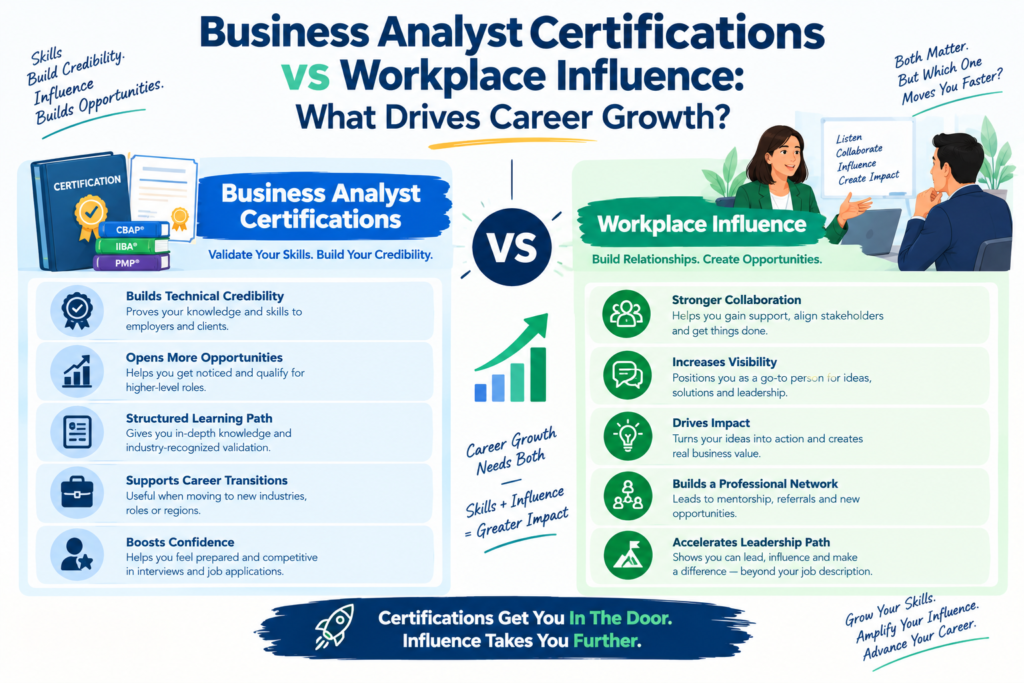
Certification will not promote you on its own, but it signals commitment and gives you a structured way to sharpen the skills leaders value. It often supports the case when less experienced business analysts get promoted. Business Analyst Course offers business analyst training with locations across Melbourne, Sydney, Brisbane and Perth, plus online options. You can learn more about our approach on the about us page. Useful next steps include:
- Business Analysis Techniques course: exam-aligned training in elicitation, modelling, business cases and acceptance testing, based on the BCS Foundation Certificate in Business Analysis syllabus.
- Top business analysis courses in Australia: compare foundation, AgileBA and requirements engineering pathways.
- Logitrain’s business analyst courses: instructor-led training delivered live in real time, in person or online, for people entering the field and for working analysts.
Ready to get started? Explore business analyst courses and choose the pathway that fits your next promotion.
FAQs: Why Less Experienced Business Analysts Get Promoted First
Why do less experienced business analysts get promoted faster than senior colleagues?
Promotions are forward-looking bets. Panels weigh visibility, outcomes, adaptability and sponsor support alongside years served, so less experienced business analysts get promoted when they show clearer signs of growth.
Do years of experience matter for a business analyst promotion?
Yes, but as context rather than proof. Experience shows you can do the work. A promotion requires evidence that you can handle bigger scope, more senior stakeholders and more ambiguity.
What do employers reward in a senior business analyst?
Ownership of outcomes, clear executive communication, stakeholder trust, coaching others and the ability to shape the approach rather than only execute it.
Does a certification help me get promoted?
It can, especially as visible evidence of commitment and structured skills, but it works best alongside results and sponsor support. Credentials such as ECBA, CCBA and CBAP from IIBA, or BCS certificates, suit different career stages.
How do I ask for a promotion as a business analyst?
Bring a short record of outcomes, ask what the next level requires and agree a timeline. Do this in regular one-on-ones instead of waiting for the annual review.
Experience Earns Trust. Impact and Visibility Earn Promotions.
If less experienced business analysts get promoted first, it is rarely because leaders undervalue expertise. It is because someone else made their impact easier to see. You do not need to become a self-promoter to change that. You need to link your work to outcomes, be known beyond your immediate team and ask clearly for the next step. Ready to strengthen the skills promotion panels notice? Explore our business analyst courses and take the next step.