
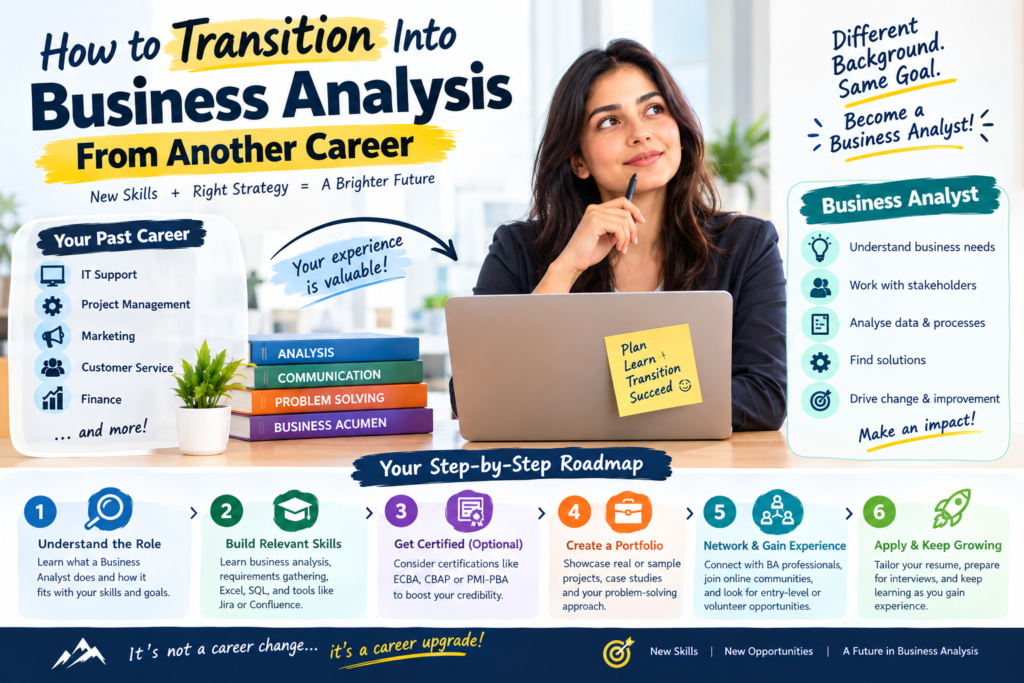

If you’re wondering how to transition into business analysis from another career, the good news is that business analysis is one of the most accessible mid-career pivots available in Australia right now it draws on skills most professionals already have, rather than requiring you to start from zero. Across Sydney, Melbourne, Brisbane, Perth, Adelaide and Canberra, employers regularly hire career-changers from teaching, banking, customer service, project coordination and operations roles into junior BA positions. This guide walks through exactly how to make that move.
Why Business Analysis Attracts So Many Career Changers
Business analysis sits at the intersection of communication, structured thinking and stakeholder management skills that show up across dozens of unrelated careers, just under different names. A high school teacher has already spent years translating complex ideas for different audiences. A bank teller has already handled process compliance and customer needs under pressure. A retail manager has already run stakeholder conversations between head office and frontline staff. The transition isn’t about learning something completely new it’s about relabelling and formalising skills you already use.
Step-by-Step: How to Transition Into Business Analysis
Step 1: Identify the Transferable Skills From Your Current Career
What to look for:
Any experience gathering requirements, documenting a process, running a meeting with competing priorities, or explaining a system to non-technical people counts as directly relevant. Candidates moving from customer service, operations, teaching, admin, finance or project coordination roles usually have more transferable experience than they realise once they map it against BA competencies.
Step 2: Learn the BA-Specific Vocabulary and Frameworks
What to focus on:
Terms like requirements elicitation, stakeholder analysis, as-is/to-be process mapping, and user stories give a name to things you may have already been doing informally. Employers in Sydney and Melbourne screen resumes for this vocabulary specifically, so learning it early changes how your existing experience reads on paper.
Step 3: Get a Recognised Business Analysis Certification
Why this matters for career changers specifically:
A certification such as AgileBA, CBAP (for more experienced candidates), or a foundation-level BA course signals to employers that your interest is serious and structured, not just a resume keyword. For someone without a BA job title yet, certification is often the single fastest way to get taken seriously by a hiring manager. Canberra government and Brisbane enterprise employers particularly value a recognised certification when a candidate’s job history doesn’t already say “Business Analyst.”
Step 4: Build Practice Projects to Prove Applied Skill
Why this closes the credibility gap:
A certification proves you understand the theory; a practice project proves you can apply it. Documenting a business requirements document, a process map, or a set of user stories for a real or fictional scenario gives you something concrete to discuss in an interview, and directly answers the “but you’ve never done this job” objection.
Step 5: Target the Right Entry Point, Not a Senior BA Role
Where career changers actually get hired:
Junior Business Analyst, Business Analyst Support, Process Analyst, or hybrid roles combining your old career with analysis (for example, a former nurse moving into a Healthcare Business Analyst role) are realistic first steps. Perth and Adelaide employers in healthcare, resources and government sectors regularly hire domain-experienced career changers over generalist junior candidates, because your industry knowledge is a genuine advantage, not a weakness.
How Your Old Career Maps to Business Analysis Skills
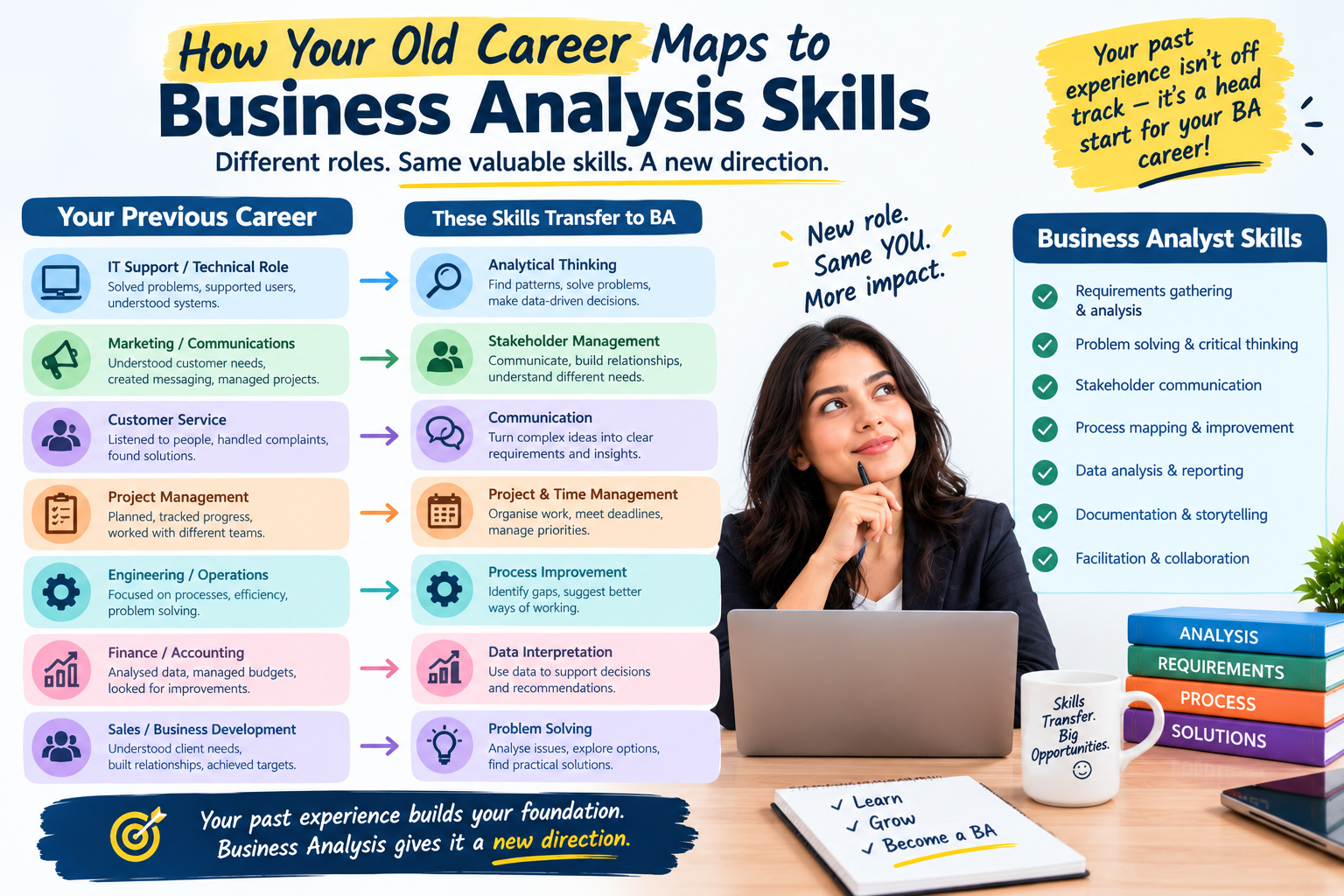
| Previous Career | Transferable Skill | How It Applies to BA |
| Teaching | Explaining complex ideas clearly | Translating requirements for non-technical stakeholders |
| Banking/finance | Process compliance, attention to detail | Documenting accurate, audit-ready requirements |
| Customer service | Managing competing needs under pressure | Stakeholder analysis and conflict resolution |
| Project coordination | Tracking tasks, timelines and dependencies | Supporting project delivery alongside a PM |
| Retail/operations management | Running cross-team communication | Facilitating workshops and status updates |
Common Mistakes Career Changers Make
- Waiting until they feel “fully qualified” before applying most successful transitions start applying while still studying.
- Rewriting their resume around their old job title instead of reframing it around transferable BA skills.
- Skipping a practice project and relying on certification alone to prove capability.
- Applying only to “Business Analyst” titled roles and ignoring hybrid or support-level entry points.
Certifications and Courses That Support This Transition
A structured course accelerates this transition by giving you the vocabulary, frameworks and guided practice projects employers expect, rather than trying to piece it together from scattered articles.
- Start with a Business Analyst Course covering requirements gathering, process mapping and certification preparation.
- Explore the related Business Analysis Course for additional certification pathway options.
- Explore the full IT and business skills catalogue at Logitrain, Australia’s long-established training provider.
Further Reading
- Current business analyst job vacancies across Australia on SEEK.
- The official Business Analysis Body of Knowledge (BABOK) overview from the International Institute of Business Analysis (IIBA).
Final Tips Before You Start Applying
- Lead your resume with transferable skills and BA vocabulary, not your old job title.
- Have one practice project ready to walk through in detail during an interview.
- Target hybrid or domain-specific BA roles that value your previous industry experience.
Ready to make the move? Explore the full Business Analyst Course at businessanalystcourse.au and get the certification, vocabulary and practice projects to transition into business analysis with confidence training available for career changers across Sydney, Melbourne, Brisbane, Perth, Adelaide and Canberra.