
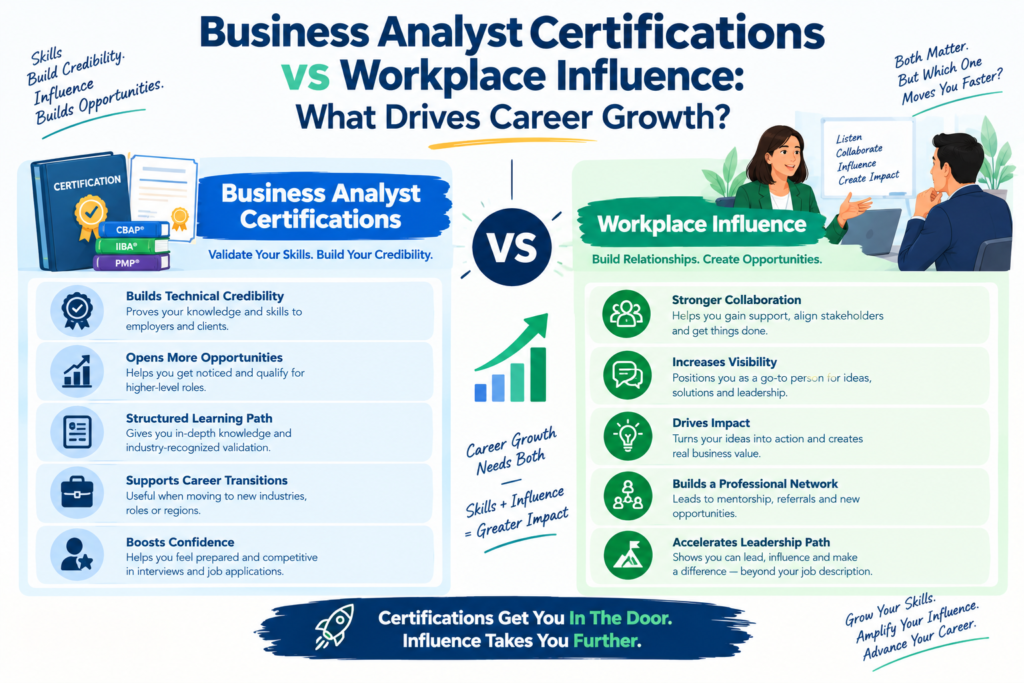

Business analyst certifications vs workplace influence is a debate that plays out quietly in almost every BA’s career, usually around the two-to-three-year mark, when a colleague with fewer letters after their name gets promoted ahead of someone holding a CBAP or CCBA. Certification proves structured knowledge of business analysis frameworks. Workplace influence the trust, credibility and informal authority a BA builds with stakeholders determines how much of that knowledge actually gets applied and recognised.
Across Sydney, Melbourne, Brisbane, Perth, Adelaide and Canberra, BAs who advance fastest are rarely the ones with the most certifications alone but they’re not the most “naturally influential” either. This guide breaks down exactly what each factor contributes to career growth, where organisations actually place weight, and how to build both deliberately.
What Certification Actually Contributes
Certifications like IIBA’s ECBA, CCBA and CBAP or PMI’s PMI-PBA formalise structured knowledge elicitation techniques, requirements lifecycle management, stakeholder analysis frameworks in a way that’s consistent and verifiable across every candidate who holds them. For recruiters and resume-screening software, certification is a fast, objective signal that reduces perceived hiring risk, particularly for candidates moving into a new organisation where no one yet has firsthand experience of their work.
What certification does well
- Provides a structured, recognised vocabulary and methodology
- Signals genuine commitment to the profession, especially for career changers
- Helps pass resume screening and recruiter shortlisting, particularly for external moves
- Creates a consistent baseline of knowledge across a team or department
What certification alone doesn’t provide
- The trust required to get a skeptical stakeholder to actually change their mind
- Visibility with the leaders who make promotion and restructuring decisions
- The judgment to know which requirement to fight for and which to let go
- A track record colleagues can vouch for internally
What Workplace Influence Actually Contributes
Workplace influence is built through consistent, demonstrated reliability showing up prepared, following through, delivering accurate work under pressure, and being the person stakeholders trust to represent their interests accurately. It’s what determines whether a BA’s recommendations actually get adopted, whether they’re invited into strategic conversations early, and whether leadership remembers their name when a senior opportunity opens up.
What influence does well
- Determines whether your recommendations actually get implemented, not just documented
- Drives internal promotion decisions more directly than certification typically does
- Builds the visibility that leads to being invited into strategic, not just operational, conversations
- Compounds over time each successful project increases credibility for the next
What influence alone doesn’t provide
- A portable, verifiable credential when moving to a new organisation
- Structured methodology knowledge that’s consistent and teachable
- An easy way to prove capability to someone who’s never worked with you before
Certification vs Influence: Where Each One Wins
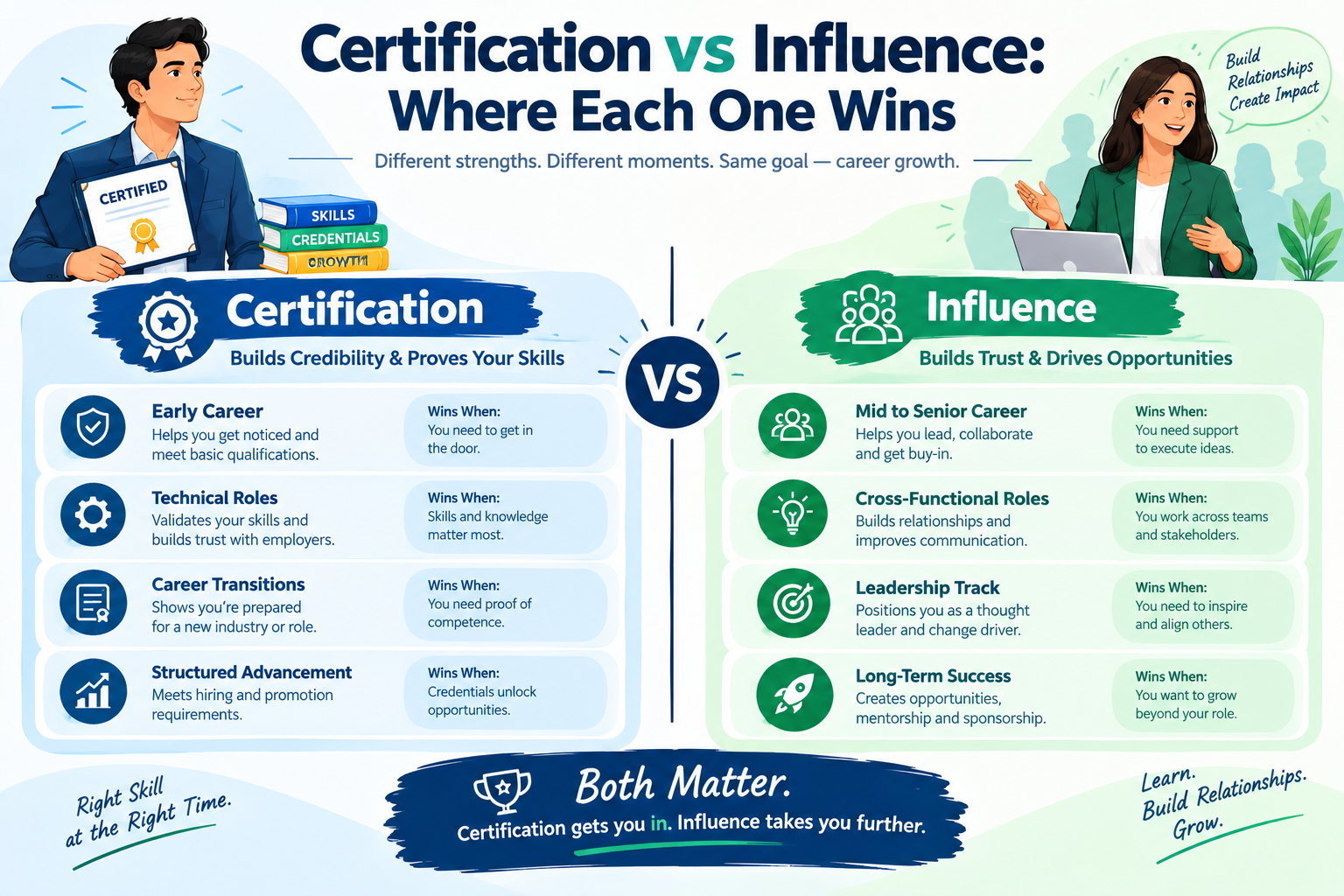
| Career Scenario | Certification’s Role | Influence’s Role |
| Applying to a new company | Primary gets you shortlisted | Secondary can’t be verified externally yet |
| Internal promotion at current employer | Supporting shows commitment | Primary usually the deciding factor |
| Getting a recommendation actually adopted | Minor | Primary trust drives adoption |
| Being invited into strategic planning | Minor | Primary visibility and credibility matter most |
| Salary negotiation | Useful leverage | Useful leverage strongest when combined |
How to Build Both Deliberately
The BAs who advance fastest treat certification and influence as complementary, not competing, investments certification to build and formalise the knowledge base, and deliberate relationship-building and follow-through to convert that knowledge into recognised impact.
Practical ways to build workplace influence alongside certification
- Follow through visibly on every commitment, even small ones reliability compounds credibility
- Volunteer for a visible, slightly uncomfortable project rather than only comfortable, familiar work
- Bring solutions, not just problems, when raising an issue with a stakeholder or sponsor
- Build relationships with people outside your immediate project team, not just your usual stakeholders
- Share credit generously colleagues remember who made them look good, and it builds reciprocal trust
Structured training accelerates the certification side of this equation while also building the applied judgment that supports influence. The business analyst training at businessanalystcourse.au pairs certification-aligned content with real scenario practice, so graduates build both the credential and the applied judgment stakeholders actually respond to.
For a deeper look at converting technical BA skill into recognised value, see our related guide: Why Smart Business Analysts Stop Writing Requirements and Start Driving Business Outcomes.
Frequently Asked Questions
Is a BA certification worth it if I already have strong workplace relationships?
Yes certification remains valuable for external job moves and resume screening, since workplace influence built at one organisation doesn’t automatically transfer to a new employer who has no firsthand experience of your work.
Can workplace influence substitute for certification entirely?
For internal promotion, often yes to a significant degree. For external hiring, rarely certification is usually what gets a candidate shortlisted in the first place, especially against unfamiliar competition.
Which matters more for a first promotion: certification or influence?
Internal promotions are typically driven more by demonstrated influence and trust than by certification alone, though certification can still support the case by demonstrating structured commitment to the profession.
Final Thoughts
Business analyst certifications vs workplace influence isn’t really a competition it’s two different levers that matter at different career moments. BAs who advance fastest across Sydney, Melbourne, Brisbane, Perth, Adelaide and Canberra are consistently the ones who build certification for portability and credibility, while deliberately investing in the reliability and relationships that convert knowledge into recognised, promotable impact.
To build both together, Logitrain offers certification-aligned BA training, and the businessanalystcourse.au and businessanalysiscourses.com.au microsites cover the practical, applied skills that build genuine workplace influence.