

The business analyst experience gap is the reason so many capable, analytical people can’t get past the first screening for a BA role. Nearly every junior business analyst listing asks for one to three years of business analysis experience, yet almost none of them explain how a candidate is supposed to get that experience without first being hired. It’s a closed loop, and it stalls out genuinely strong candidates before they ever reach an interview.
The frustrating part is that the business analyst experience gap usually has very little to do with ability. Many candidates already do BA-style work inside other roles, clarifying requirements, analysing data, improving a process, without ever calling it business analysis. The gap is less about missing skill and more about missing proof, framing and the right certification to back it up.
What Is the Business Analyst Experience Gap, Really?
The business analyst experience gap is the space between having analytical, requirements-gathering and stakeholder skills and being able to demonstrate them in language a hiring manager or ATS immediately recognises as business analysis experience. A customer service lead who has tracked recurring complaints, an operations coordinator who streamlined a handover process, or a QA tester who has clarified requirements with developers may already be doing BA work, just without the job title, the certification, or the vocabulary to prove it on a resume.
Why the Business Analyst Experience Gap Keeps Candidates Out of Their First Role
A handful of structural issues combine to create the business analyst experience gap. Here are the five that come up most often.
1. Job Ads Asking for “Junior” BAs with 2–3 Years’ Experience
Entry-level BA listings routinely ask for experience that entry-level candidates can’t yet have. This mismatch, more than any lack of talent, is the single biggest driver of the business analyst experience gap.
2. No Recognised Certification or Methodology to Point To
Without a recognised qualification, a resume has nothing concrete to anchor claims of BA capability to. Certifications signal that a candidate understands standard techniques, requirements documentation and stakeholder management in a way employers can trust without needing prior job history to prove it.
3. Resumes That List Duties Instead of Business Outcomes
“Assisted with reporting” tells a hiring manager almost nothing. “Identified a reporting error that was skewing monthly forecasts by 12%” tells them exactly what kind of analyst you are. Vague, duty-based resumes widen the business analyst experience gap even when the underlying work was genuinely analytical.
4. ATS Filtering Out Resumes Missing Exact Keywords
Applicant tracking systems scan for specific terms: requirements gathering, stakeholder management, process mapping, user stories, Agile. A resume written in casual, job-specific language can be filtered out automatically, regardless of how relevant the underlying experience actually is.
5. Weak Interview Answers on Requirements Gathering and Stakeholder Management
Even candidates who get an interview often struggle to describe their process clearly: how they gathered requirements, resolved conflicting stakeholder views, or validated a solution against the original business need. Interviewers are listening for structured thinking, not just enthusiasm.
How to Fix the Business Analyst Experience Gap
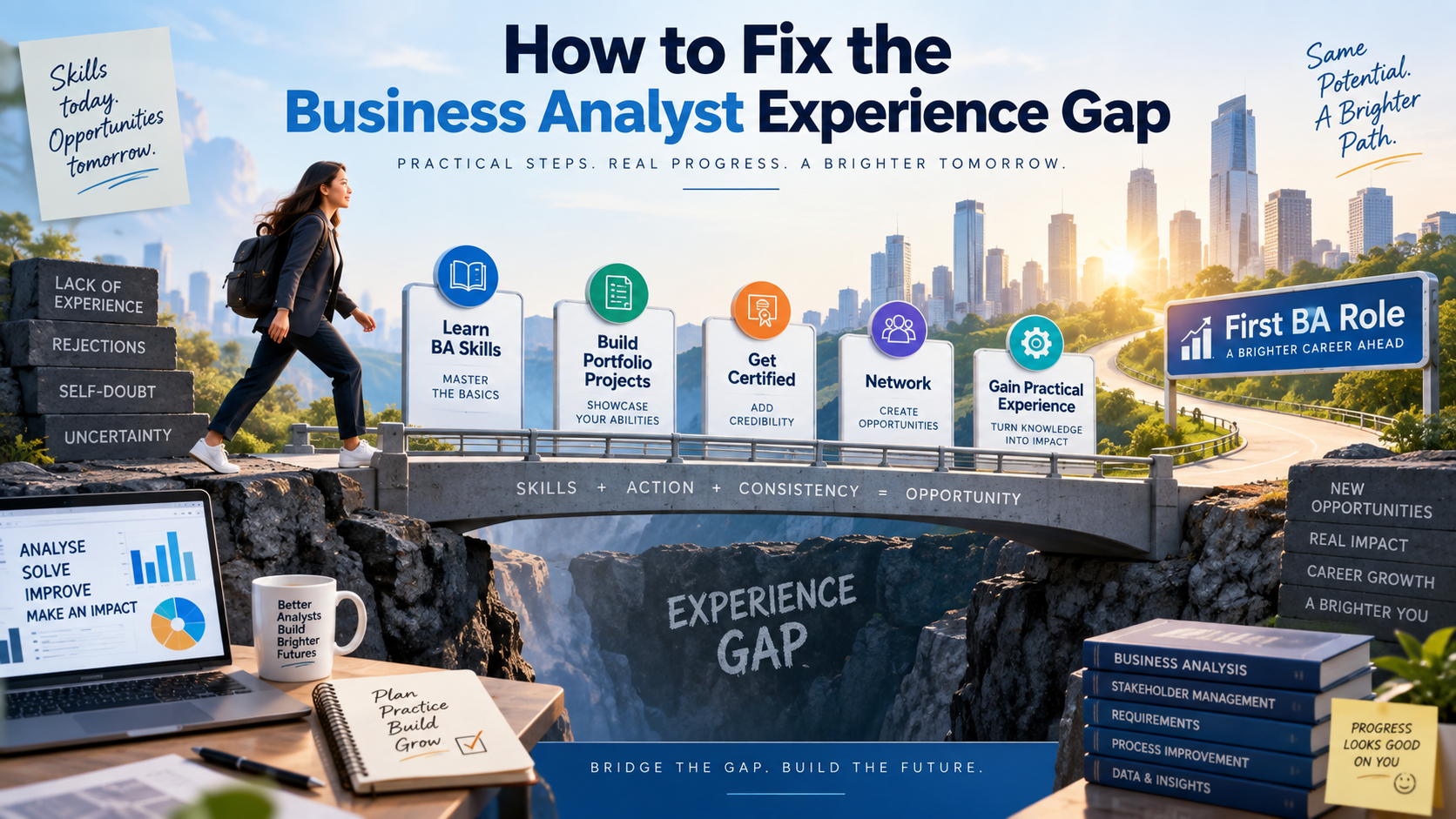
Every one of these causes is fixable, usually faster than candidates expect. Here’s how to close the business analyst experience gap deliberately.
Treat Adjacent Experience as Real BA Experience
Requirements-style work you’ve already done in another role counts. Reframe it in BA language: what business problem you identified, what you analysed, what you recommended, and what changed as a result.
Get a Recognised Certification or Foundation
A recognised business analysis qualification gives hiring managers a fast, trusted signal that closes a large part of the business analyst experience gap in one step, especially when combined with hands-on practice rather than theory alone.
Build a Small Portfolio of Analyst-Style Outputs
A sample requirements document, a process map, or a short business case built on a real or hypothetical scenario gives interviewers something concrete to discuss, and shows structured thinking in action.
Learn Agile and Core BA Techniques Properly
Fluency in core techniques, requirements elicitation, process modelling, user stories and Agile ways of working, is what separates a candidate who can talk about BA work from one who can actually do it from day one.
Closing the Gap with the Right Training
Structured, certification-focused training is one of the fastest ways to close the business analyst experience gap, because it builds real technique alongside a credential employers recognise. Business Analyst Courses offers instructor-led training aligned with the skills employers screen for.
Popular pathways to build genuine, job-ready BA capability include:
- Fast Start in Business Analysis — a practical entry point into core BA skills
- Business Analysis Practice Practitioner — applying BA techniques to real scenarios
- Agile Business Analyst (AgileBA) Foundation — BA work inside Agile delivery teams
- Business Analysis Techniques — requirements gathering and process modelling
- BCS Business Analysis Foundation — a widely recognised, employer-trusted certification
- AWS Business Essentials — cloud fundamentals for technology-facing BA roles
Each course combines practical techniques with certification pathways, so the business analyst experience gap closes on both fronts at once: real skill, and proof employers trust.
Business Analyst Courses Available in Cities Across Australia
Training is available in person or live virtually, so wherever you’re based, you can start closing the business analyst experience gap: Sydney, Melbourne, Brisbane, Perth, Adelaide, and Canberra.
Frequently Asked Questions
What exactly is the business analyst experience gap?
The business analyst experience gap is the mismatch between candidates who already have relevant analytical skills and their ability to prove it through certification, resume language and portfolio evidence a hiring manager or ATS recognises.
Can you become a business analyst with no direct BA job title?
Yes. Adjacent experience in operations, customer service, QA or project coordination often includes genuine BA-style work. Reframing it clearly, alongside a recognised certification, is usually enough to close the gap.
Does certification really help close the business analyst experience gap?
Yes. A recognised qualification gives employers a fast, trusted signal of capability that doesn’t depend on prior job history. Structured programs like Business Analyst Courses are built specifically to provide that.
What should a first BA resume focus on?
Focus on business outcomes rather than duties: what problem you identified, what you analysed, what you recommended, and what changed, using the exact terminology (requirements gathering, stakeholder management, process mapping) that both humans and ATS systems screen for.
Ready to close the business analyst experience gap and land your first BA role? Contact the Business Analyst Courses team and get matched with the right training pathway.